
Compound/Compounds
CJC-1295 + Ipamorelin: Two different paths to the growth-hormone axis
One is a long-acting GHRH analog that kept IGF-1 elevated for days in healthy adults. The other is a selective ghrelin-receptor secretagogue with a distinctive hormone panel in animals. A blend is two literatures sharing a vial.
Inspired Labs Editorial/Sep 7, 2026/3 sources
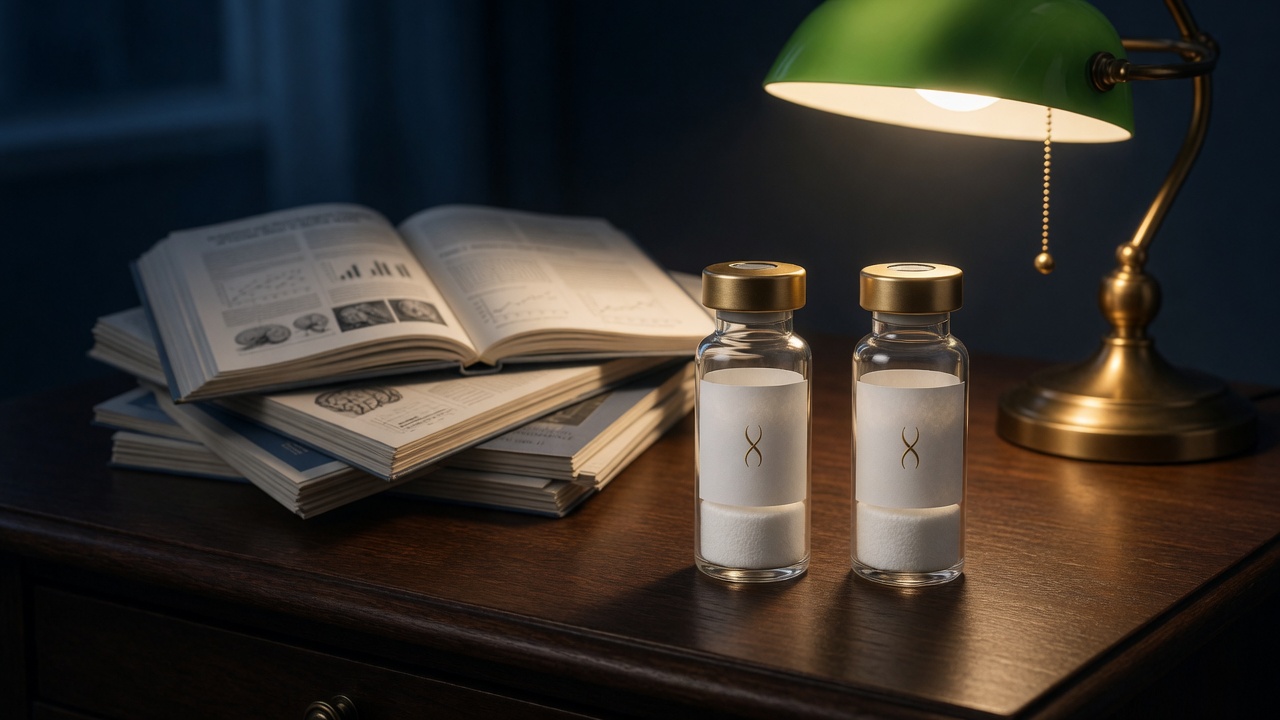
CJC-1295 + Ipamorelin: Two different paths to the growth-hormone axis
People pair these two because they sound complementary: one for a longer baseline, one for a pulse. The papers are more precise than the forums. CJC-1295 is a growth-hormone-releasing-hormone analog with a Drug Affinity Complex that binds albumin, stretching the half-life into days. Ipamorelin is a five-residue ghrelin-receptor agonist. They do not bind the same receptor. They do not last the same amount of time. A blend is a purchasing convenience — two sequences in one tube — not a new molecule.
What Teichman measured in people
In 2006, Teichman and colleagues gave healthy adults subcutaneous CJC-1295 in randomized, placebo-controlled, ascending-dose work. After one injection, mean plasma GH rose 2- to 10-fold for six days or more, and mean IGF-I rose 1.5- to 3-fold for nine to eleven days. Estimated half-life: 5.8 to 8.1 days. After several doses, IGF-I stayed above baseline for up to 28 days. A companion paper by Ionescu and Frohman showed the pituitary still pulsed. What rose hard was the trough. That trough, not a taller spike, tracked the IGF-I increase — a detail that softens some of the simpler “night pulse” storytelling online.
What Raun measured that set ipamorelin apart
Ipamorelin was published in 1998 as the first GHRP-receptor agonist with GHRH-like selectivity for GH. In rat pituitary cells it released GH with potency in the same neighborhood as GHRP-6. In anaesthetized rats and in swine it did the same. The difference: GHRP-6 and GHRP-2 also moved ACTH and cortisol. Ipamorelin did not, even at doses more than two hundred times the GH ED50. That selectivity is why it became the “clean” secretagogue in later catalogs. Clean, in that paper, means a hormone panel in animals — a specific preclinical finding worth taking on those terms.
Two receptors, two time scales — and one vial that still asks you to read two papers.
Sources
- 01Prolonged stimulation of GH and IGF-I secretion by CJC-1295, a long-acting analog of GHRH, in healthy adults — Teichman SL, Neale A, Lawrence B, et al. (2006). Journal of Clinical Endocrinology & Metabolism.
PMID 16352683. Single subcutaneous doses raised mean GH 2- to 10-fold for ≥6 days and IGF-I 1.5- to 3-fold for 9–11 days. Half-life ~6–8 days.
- 02Pulsatile secretion of GH persists during continuous stimulation by CJC-1295 — Ionescu M, Frohman LA. (2006). Journal of Clinical Endocrinology & Metabolism.
PMID 17018654. Pulsatility preserved; trough GH rose 7.5-fold. The trough, not the peak, tracked the IGF-I rise.
- 03Ipamorelin, the first selective growth hormone secretagogue — Raun K, Hansen BS, Johansen NL, et al. (1998). European Journal of Endocrinology.
PMID 9849822. Pentapeptide GHRP-receptor agonist. GH release comparable to GHRP-6 in rats and swine, without ACTH or cortisol even at >200× the GH ED50.
Educational material for laboratory research context only. Nothing here is medical advice, a protocol for human use, or a claim that Inspired Labs products diagnose, treat, cure, or prevent disease.
Continue
What a peptide actually is
Methods
What a peptide actually is
Read brief → 7 min

How GLP-1 changed metabolic research
Compound
How GLP-1 changed metabolic research
Read brief → 9 min
TB-500 and Thymosin β4: Why the difference matters
Compound
TB-500 and Thymosin β4: Why the difference matters
Read brief → 8 min