Methods
What a peptide actually is
A short chain of amino acids — the same building blocks as proteins, stopped before a full fold. Here is why that length still matters in cells, and how a research vial fits the picture.
Inspired Labs Editorial/Sep 8, 2026/3 sources
What a peptide actually is
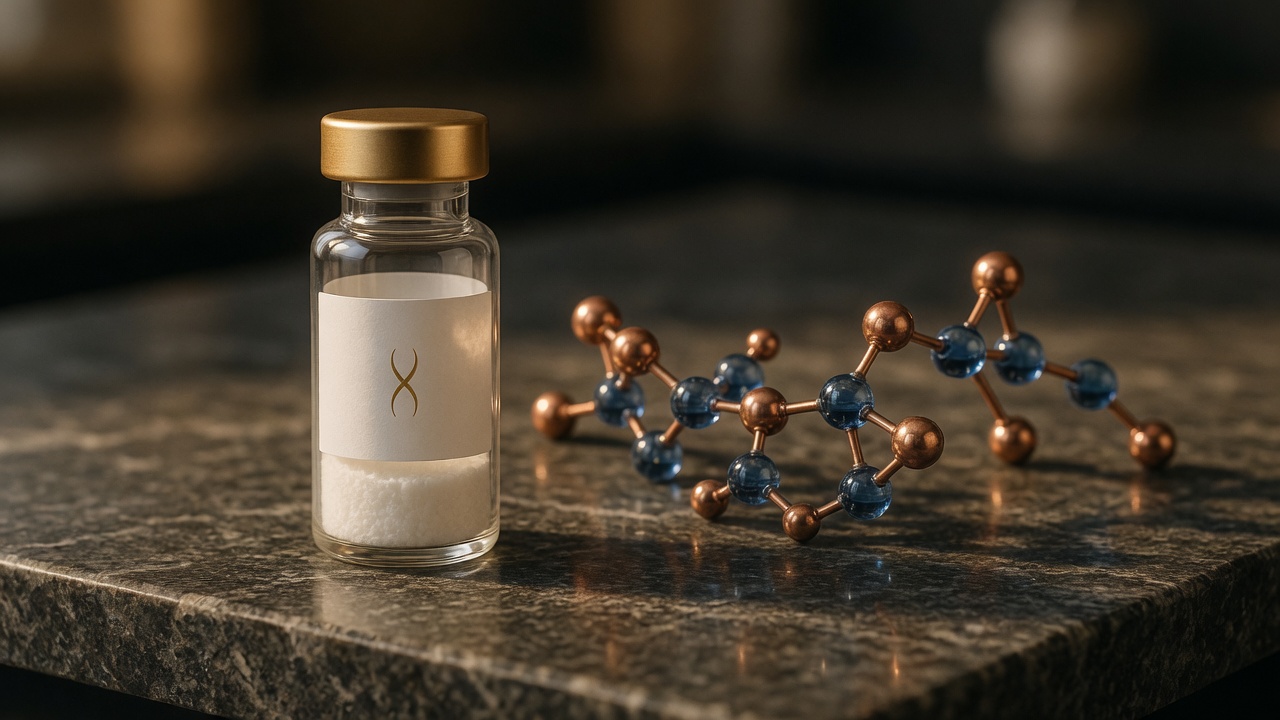
If you have been online in the last three years, you have heard the word everywhere — gyms, spas, podcasts. Underneath the noise is a simple molecule. A peptide is a short chain of amino acids, the same twenty building blocks that make every protein in a body, stopped before it becomes a fully folded protein. Insulin is a peptide. Oxytocin is a peptide. The copper tripeptide GHK-Cu is three residues long. The difference between a rumor and a reagent is whether anyone can name the sequence.
Why a short chain can still do something
Cells talk with shapes. A receptor on a membrane is a lock. A peptide can be a key that fits well enough to turn something on, turn something off, or recruit a partner. That is why GHK, isolated from human plasma in the 1970s, can change how fibroblasts handle collagen in culture, and why a 15-residue gastric fragment shows up across a large rodent injury literature. Length is not the same as power. Specificity is often where the power lives.
A peptide is a sequence you can write down — and that alone already separates chemistry from atmosphere.
What gets collapsed online is the next step. A signal in a dish is one kind of finding. A lyophilized cake in a research vial is a chemical with a lot number, a chromatogram, and an intended use: laboratory research. Inspired Labs sells that chemical. This journal exists so you can read the papers with curiosity — and without borrowing a clinic’s vocabulary by accident.
A friendly place to start is a compound people already recognize — GHK-Cu is the copper-peptide conversation — then read the evidence grade on the card. The live catalog is the handoff: same sequence, lot documentation, research use only.
Sources
- 01Peptides: chemistry and biology — Sewald N, Jakubke HD. (2015). Wiley-VCH.
Working definition: peptides are short amino-acid polymers, typically distinguished from proteins by length and folding complexity.
- 02The human tri-peptide GHK and tissue remodeling — Pickart L. (2008). Journal of Biomaterials Science, Polymer Edition.
A three-residue peptide isolated from human plasma — proof that a very short sequence can still be a biological signal.
- 03Inspired Labs live catalog (2026). Inspired Labs.
Lot-level research chemicals. The journal explains the literature; the catalog lists the materials.
Educational material for laboratory research context only. Nothing here is medical advice, a protocol for human use, or a claim that Inspired Labs products diagnose, treat, cure, or prevent disease.
Continue

How GLP-1 changed metabolic research
Compound
How GLP-1 changed metabolic research
Read brief → 9 min

CJC-1295 + Ipamorelin: Two different paths to the growth-hormone axis
Compound
CJC-1295 + Ipamorelin: Two different paths to the growth-hormone axis
Read brief → 9 min
TB-500 and Thymosin β4: Why the difference matters
Compound
TB-500 and Thymosin β4: Why the difference matters
Read brief → 8 min