Compound/Compounds
NAD+: The molecule connecting cellular energy, metabolism, and aging research
Levels of this coenzyme fall with age in many tissues. Precursors reverse pieces of that story in mice. Human evidence is real, uneven, and mostly about NMN and NR — adjacent to, and not identical with, a lyophilized dinucleotide on a research shelf.
Inspired Labs Editorial/Sep 5, 2026/3 sources
NAD+: The molecule connecting cellular energy, metabolism, and aging research
NAD+ is a coenzyme every cell uses to move electrons, and a substrate that sirtuins, PARPs, and CD38 spend like currency. When the pool shrinks, those enzymes have less to work with. Yoshino, Baur, and Imai have spent a decade writing that sentence carefully: age-related NAD+ decline is measurable in many tissues; raising the pool with precursors (nicotinamide mononucleotide, nicotinamide riboside) repairs pieces of metabolic aging in mice; human trials exist and are smaller, shorter, and less cinematic than clinic-menu storytelling.
Mice, precursors, and the material in the vial
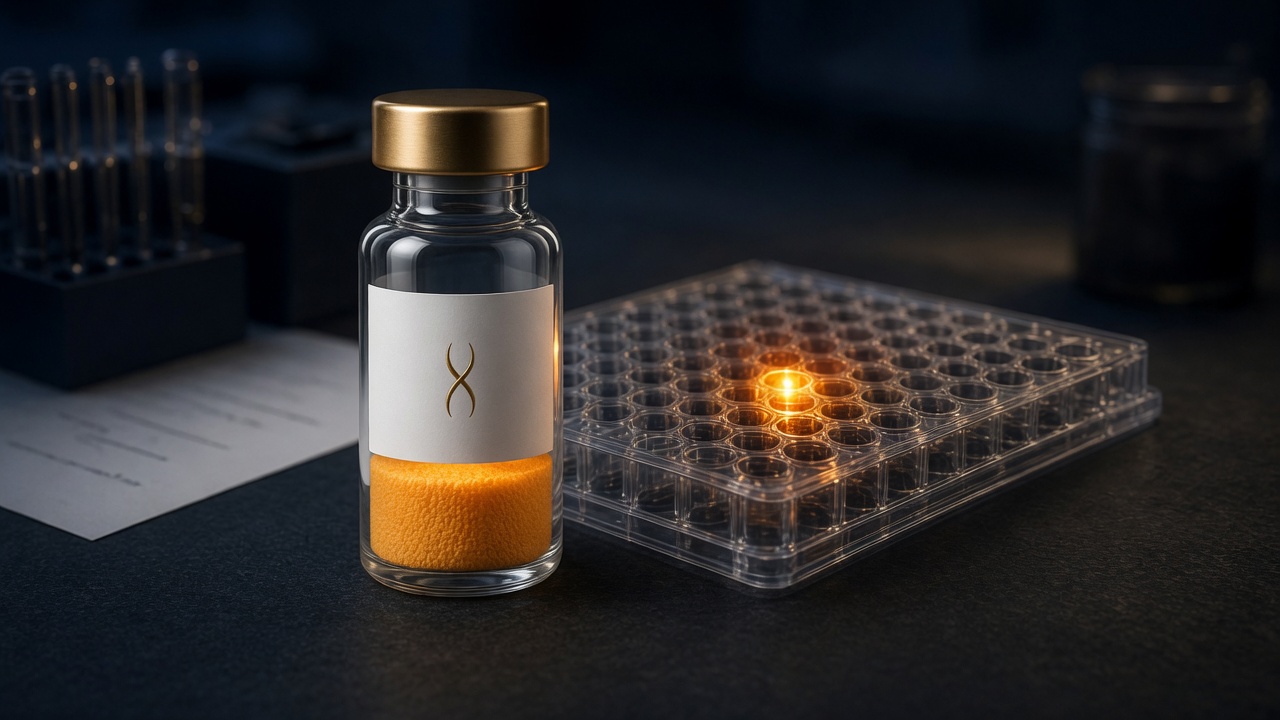
Mills and colleagues gave mice NMN for a year and reported better energy metabolism, insulin sensitivity, and physical activity without an obvious toxicity signal. That is a landmark aging-metabolism paper. It is also oral NMN in C57BL/6N mice — a different experimental object from lyophilized NAD+ in a research vial, and from a short clinic infusion. Most of the careful human work has used NR or NMN, which cells can take up and convert. NAD+ itself is a larger, charged dinucleotide. Keeping those three names distinct is basic chemistry — and it clarifies what any given lot can actually help you study.
A coenzyme is a tool the cell already uses. Experiments ask whether changing the pool changes the outcome — and which molecule you used to try.
The 2023 Endocrine Reviews appraisal is the adult version of the conversation: cardiometabolic signals in early human precursor studies, lots of unknowns, and no finished license to treat a research lot as a longevity drug. Inspired Labs sells NAD+ as a research chemical for NAD-pool and redox assays. If that is the experiment, the 100 mg, 500 mg, and 1000 mg lots are in the live catalog.
Sources
- 01NAD+ intermediates: the biology and therapeutic potential of NMN and NR — Yoshino J, Baur JA, Imai SI. (2018). Cell Metabolism.
PMID 29174459. Canonical review of why NAD+ falls, what sirtuins and PARPs do with it, and why precursors are the experimental lever in much of the modern work.
- 02Nicotinamide adenine dinucleotide in aging biology: potential applications and many unknowns — Yoshino J, Baur JA, Imai SI. (2023). Endocrine Reviews.
PMID 37364580. Critical appraisal of precursor trials in cardiometabolic aging. Plausible biology, unfinished human outcomes.
- 03Long-term administration of NMN mitigates age-associated physiological decline in mice — Mills KF, Yoshida S, Stein LR, et al. (2016). Cell Metabolism.
PMID 28068222. Twelve-month oral NMN in mice: energy metabolism, insulin sensitivity, activity — a mouse aging paper with clear scope.
Educational material for laboratory research context only. Nothing here is medical advice, a protocol for human use, or a claim that Inspired Labs products diagnose, treat, cure, or prevent disease.
Previous
Semax and Selank: Two peptides with an unusual history in Russian neuroscience
Next
GLOW and KLOW: Why blends need separate evidence stories
Continue
What a peptide actually is
Methods
What a peptide actually is
Read brief → 7 min
How GLP-1 changed metabolic research
Compound
How GLP-1 changed metabolic research
Read brief → 9 min

CJC-1295 + Ipamorelin: Two different paths to the growth-hormone axis
Compound
CJC-1295 + Ipamorelin: Two different paths to the growth-hormone axis
Read brief → 9 min