Methods
How to read a certificate of analysis
A COA is a lot-specific lab record. Match the lot, check the method, and separate identity from purity — that is most of the skill.
Inspired Labs Editorial/Sep 4, 2026/2 sources
How to read a certificate of analysis
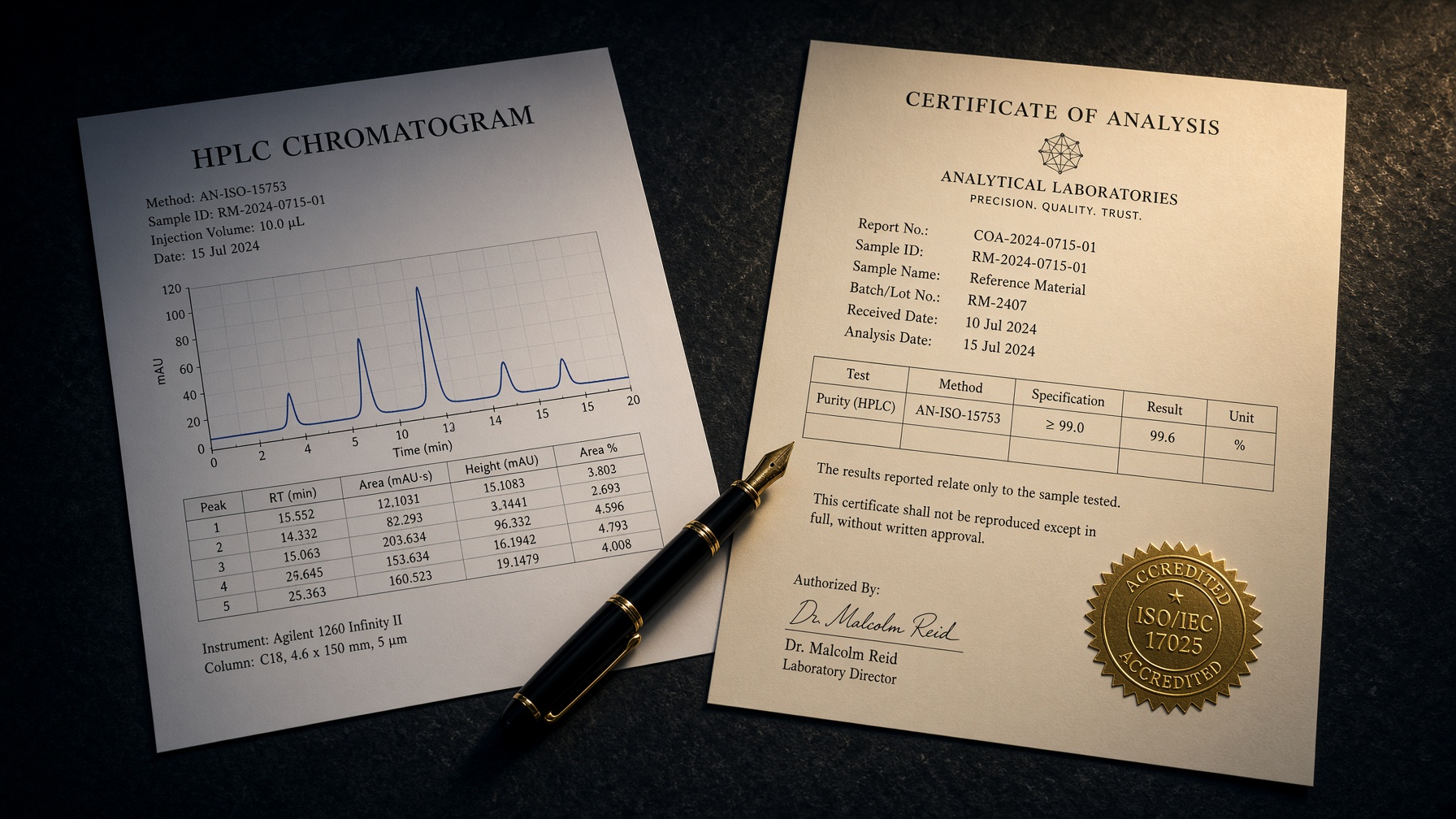
A certificate of analysis looks like paperwork until you need one. At its best, it is a simple story: a laboratory measured a defined lot, with a named method, on a named date. Lot, method, date — if those three are present and match the vial in front of you, you have something useful. If they are missing, the PDF is mostly atmosphere.
What the document should name
Start with the lot number. The certificate and the vial should agree. Then look for sequence or chemical name, stated mass, date of analysis, the laboratory, and the method. HPLC (USP <621>) reports how much of the detected signal sits under the main peak. That purity figure is valuable — and incomplete on its own. It tells you about the chromatogram. It does not, by itself, prove that the peak is the sequence you think it is.
Identity is a different measurement. Mass spectrometry asks whether the molecular ion matches the theoretical mass of the sequence. A purity claim with a clear chromatogram and an MS identity check is a finished sentence. A purity percentage with no lot, no MS, and a generic chromatogram from years ago leaves the interesting half of the question unanswered.
Purity says how clean the main peak looks. Identity asks whether that peak is the molecule you named.
Tests that often sit in the fine print
Endotoxin (LAL) and sterility matter for anyone running cell work. A culture does not read brand copy; it does respond to lipopolysaccharide. Inspired Labs sells research chemicals, not injectables for people — and that is exactly why the COA still earns its keep. Contaminants change assays whether or not anyone planned for them.
Net peptide content is easy to confuse with purity. Purity asks what fraction of the peptide material is the target sequence. Content asks how much peptide, versus salts and water, is in the vial. A 99% pure peptide at 70% content is not 10 mg of sequence; it is closer to 7 mg, plus counter-ions, plus humidity. Labs that report both numbers are being precise. That precision is what a careful assay needs.
Inspired Labs publishes lot-level documentation so a researcher can check the record instead of guessing. Trust is friendly. Methods are better.
Sources
- 01USP General Chapter <621> Chromatography (2023). United States Pharmacopeia.
Defines HPLC system suitability, resolution, and reporting — the method family behind most peptide purity claims.
- 02Mass spectrometry for peptide identification — Steen H, Mann M. (2004). Nature Reviews Molecular Cell Biology.
Why a purity percentage without an identity spectrum is an unfinished measurement.
Educational material for laboratory research context only. Nothing here is medical advice, a protocol for human use, or a claim that Inspired Labs products diagnose, treat, cure, or prevent disease.
Previous
GLOW and KLOW: Why blends need separate evidence stories
Next
What Research Use Only actually means
Continue
What a peptide actually is
Methods
What a peptide actually is
Read brief → 7 min
How GLP-1 changed metabolic research
Compound
How GLP-1 changed metabolic research
Read brief → 9 min
CJC-1295 + Ipamorelin: Two different paths to the growth-hormone axis
Compound
CJC-1295 + Ipamorelin: Two different paths to the growth-hormone axis
Read brief → 9 min