
Regulatory/Regulation
What Research Use Only actually means
RUO is an intended-use boundary in plain English: the product is for laboratory research, not for diagnosing, treating, or curing disease — and a footer disclaimer cannot rewrite a product story that points the other way.
Inspired Labs Editorial/Sep 3, 2026/3 sources

What Research Use Only actually means
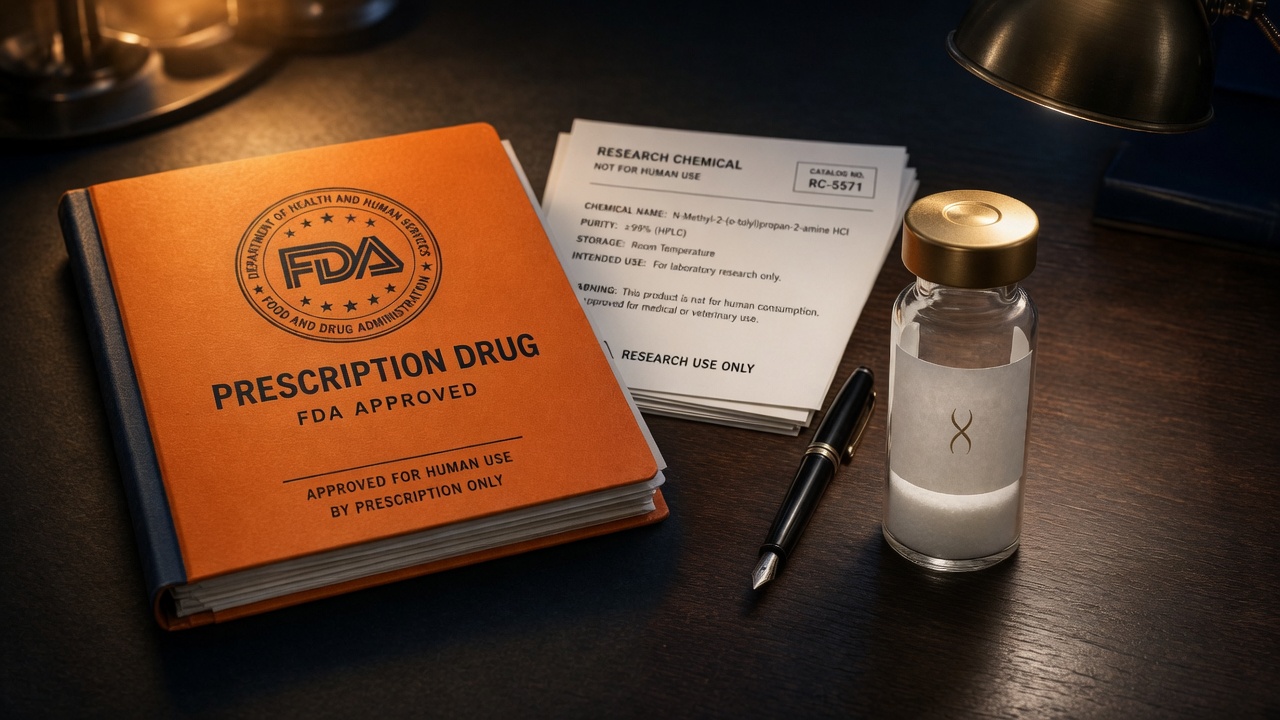
“For research use only” sounds like fine print until you notice how regulators read it. They treat it as a statement of intended use. If photographs, captions, and guides describe human treatment, a footer disclaimer does not quietly reverse that story. Intended use is about the whole presentation — what the product is offered for — not only the smallest type on the page.
Compounding is a different pathway
503A and 503B compounding is how a pharmacy may prepare a drug that is not a commercially available FDA-approved product, under conditions set out in the FD&C Act. It is a regulated pharmacy pathway, not a research-chemical website becoming a clinic. FDA’s Category 2 list exists for bulk substances nominated for compounding that the Agency has said may present significant safety risks — immunogenicity, impurity, and limited human data among the concerns.
BPC-157 sat in that Category 2 conversation after 2023. In July 2026 the Pharmacy Compounding Advisory Committee put BPC-157, KPV, TB-500, and MOTS-c related bulk substances on the agenda for 503A list discussion. An agenda is a public conversation — useful context, not an approval. A committee discussion sits well short of an NDA. A research vial on a storefront remains a research chemical: distinct from a compounded drug, from Forzinity, and from a prescription.
Intended use is read from the whole product story — photos, captions, and claims — not from the footer alone.
The 2026 vendor shakeout — warning letters, shutdowns, and a proposed SAFE Drugs Act conversation around research chemicals that are biologically identical to approved drugs — is what a market looks like when intended use was treated casually. The steadier response is a narrower claim: this is a chemical for laboratory research, with a lot number you can check.
Sources
- 01Certain bulk drug substances for use in compounding that may present significant safety risks (2023). U.S. Food and Drug Administration.
Category 2 interim policy: substances FDA has flagged for significant safety risks when nominated for 503A/503B compounding.
- 02July 23–24, 2026 Meeting of the Pharmacy Compounding Advisory Committee (2026). U.S. FDA Advisory Committee Calendar.
PCAC agenda names BPC-157, KPV, TB-500, and MOTS-c related bulk substances for 503A list discussion. Discussion is not approval.
- 03Research Use Only (RUO) products (2024). U.S. FDA — In Vitro Diagnostics.
FDA’s RUO framing for products not intended for diagnostic or clinical use. The phrase limits intended use; it is not a clinical pathway.
Educational material for laboratory research context only. Nothing here is medical advice, a protocol for human use, or a claim that Inspired Labs products diagnose, treat, cure, or prevent disease.
Previous
How to read a certificate of analysis
Next
GHK-Cu: The copper peptide with decades of research behind it
Continue

What a peptide actually is
Methods
What a peptide actually is
Read brief → 7 min
How GLP-1 changed metabolic research
Compound
How GLP-1 changed metabolic research
Read brief → 9 min

CJC-1295 + Ipamorelin: Two different paths to the growth-hormone axis
Compound
CJC-1295 + Ipamorelin: Two different paths to the growth-hormone axis
Read brief → 9 min