Compound/Compounds
GHK-Cu: The copper peptide with decades of research behind it
Loren Pickart isolated GHK from human plasma in the 1970s. The copper complex that followed built a real dermal literature — worth reading on its own terms.
Inspired Labs Editorial/Sep 2, 2026/2 sources
GHK-Cu: The copper peptide with decades of research behind it
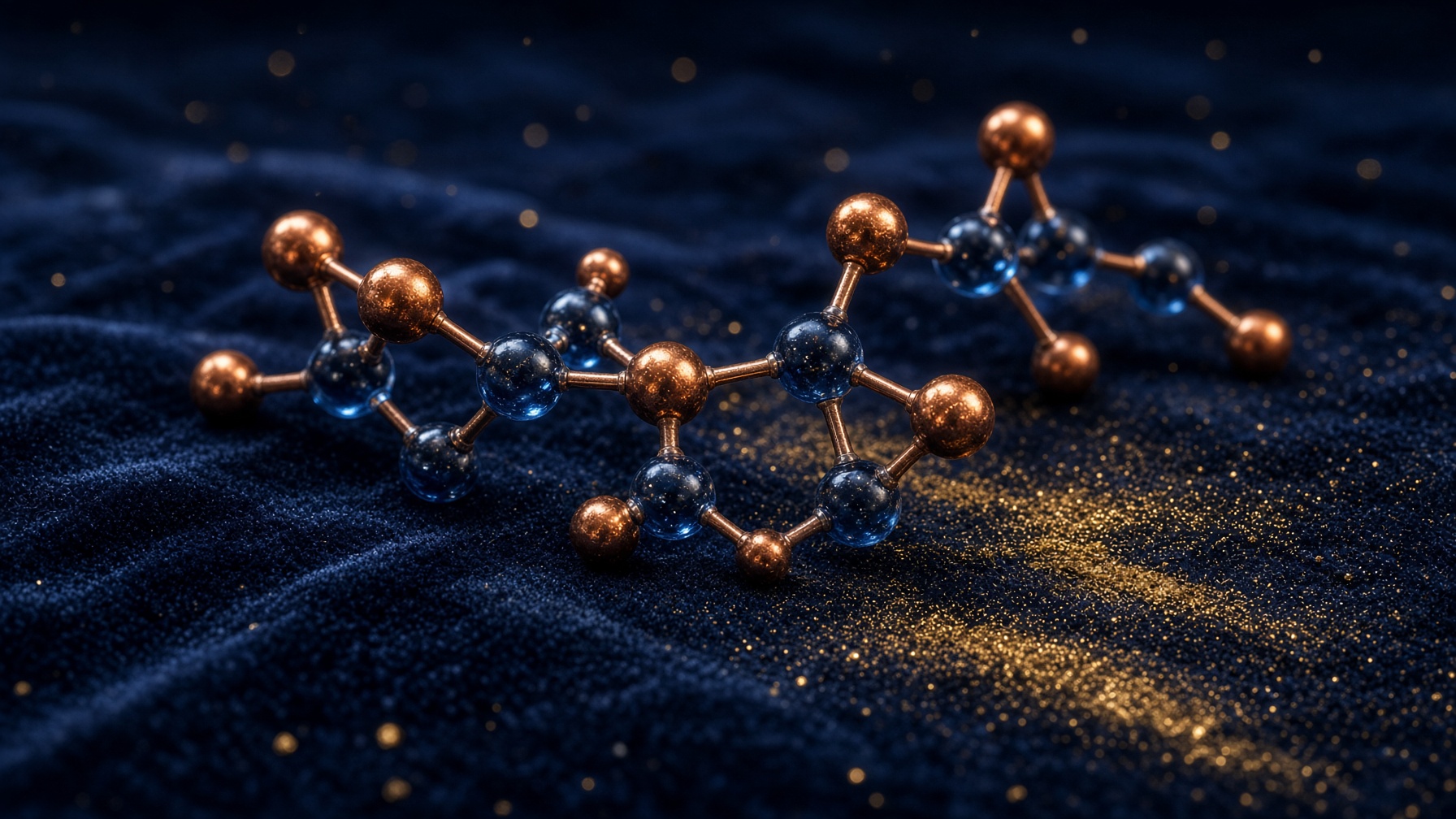
GHK (glycyl-L-histidyl-L-lysine) was isolated from human plasma by Loren Pickart in the 1970s as a factor that appeared to reverse age-related suppression of protein synthesis in liver tissue. The copper(II) complex, GHK-Cu, is the form that dominates cosmetic and research conversations today. That origin story is a published isolation — a genuine starting point — and everything after it rewards the same careful reading.
What the 2018 review actually covers
Pickart and Margolina’s 2018 International Journal of Molecular Sciences review (PMC6073405) is the paper often compressed into “GHK-Cu turns on 4,000 genes.” The paper does report Broad Institute Connectivity Map gene-expression work, and it summarizes topical human studies: a 12-week facial cream on 71 women; an eye cream on 41 women; a thigh-collagen comparison against vitamin C and retinoic acid; a nano-lipid GHK-Cu serum versus Matrixyl 3000 on wrinkle volume. Those are cosmetic, topical, and in several cases open-label or industry-adjacent. They are real data points. They are also a different experimental setting from a lyophilized research lot reconstituted for bench work.
A topical cream study and a research powder can share a sequence while answering different questions.
In fibroblast culture, GHK-Cu has been reported to alter collagen, elastin, MMP-1, MMP-2, and TIMP-1 at nanomolar concentrations. That is a bench finding with a dose unit of nM — useful for thinking about mechanism, and a reminder that culture concentrations and catalog milligrams live in different measurement worlds.
If you work with GHK-Cu in a laboratory, the interesting questions are still close to Pickart’s originals: copper handling, extracellular-matrix transcription, and whether a tripeptide-copper complex acts more like a signal or a nutrient. Those questions fit an experiment design. They are also why this compound keeps showing up in serious dermal research decades later.
Sources
- 01Regenerative and Protective Actions of the GHK-Cu Peptide in the Light of New Gene Data — Pickart L, Margolina A. (2018). International Journal of Molecular Sciences.
PMID 29986520. Reviews gene-expression data and topical human cosmetic studies. Not a trial of lyophilized RUO vials.
- 02The human tri-peptide GHK and tissue remodeling — Pickart L. (2008). Journal of Biomaterials Science, Polymer Edition.
Context for GHK as a remodeling signal discovered in human plasma in the 1970s.
Educational material for laboratory research context only. Nothing here is medical advice, a protocol for human use, or a claim that Inspired Labs products diagnose, treat, cure, or prevent disease.
Previous
What Research Use Only actually means
Next
BPC-157: Why the animal research gets so much attention
Continue
What a peptide actually is
Methods
What a peptide actually is
Read brief → 7 min
How GLP-1 changed metabolic research
Compound
How GLP-1 changed metabolic research
Read brief → 9 min
CJC-1295 + Ipamorelin: Two different paths to the growth-hormone axis
Compound
CJC-1295 + Ipamorelin: Two different paths to the growth-hormone axis
Read brief → 9 min