
After menopause/Compounds
Hot Flashes Have a Peptide Problem, Not a Peptide Fix
Hot flashes really do run partly on a brain peptide. The approved fixes don't add a peptide. They're pills that turn that signal down, and the non-prescription habits with the best evidence aren't the ones you'd guess.
Inspired Labs Editorial/Oct 26, 2026/12 sources
Hot Flashes Have a Peptide Problem, Not a Peptide Fix
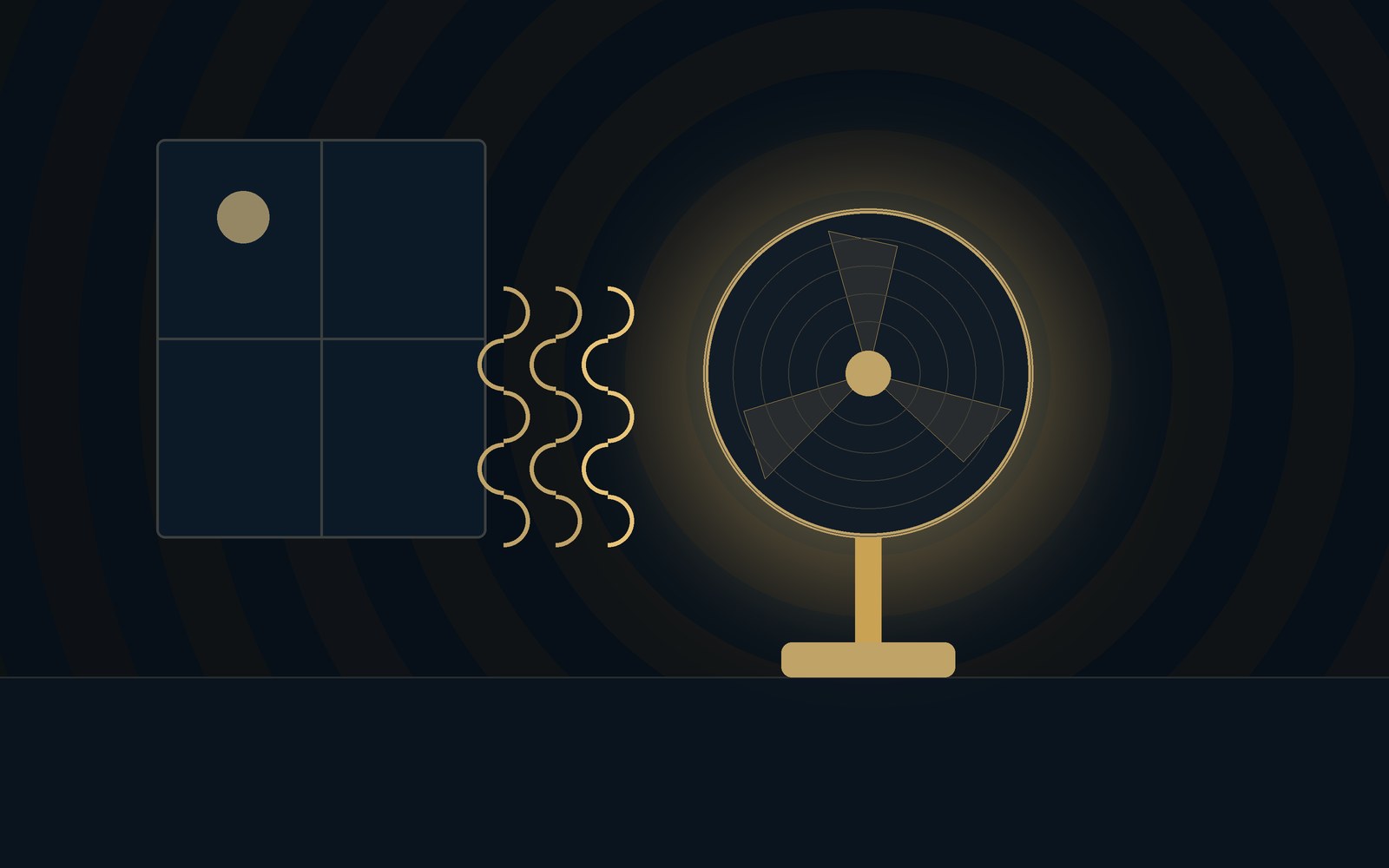
It's 3 a.m., the sheets are damp, and you've kicked the blanket off for the fourth time. Your partner is asleep under a duvet. Same bed, two climates.
If you've been scrolling menopause videos, you've probably seen peptides pitched as the answer. Here's the twist: hot flashes really do have a peptide behind them. Just not the way those posts suggest.
What's actually happening at 3 a.m.?
Deep in your brain, right next to your body's thermostat, sits a small cluster of nerve cells. Scientists nicknamed them KNDy neurons (say "candy"), after the three messengers they use: kisspeptin, neurokinin B and dynorphin.
Estrogen normally keeps these cells calm. When it drops, they get louder. Back in 1991, researchers studying brain tissue found the neurokinin B cells were nearly twice as big in women after menopause.
Picture a smoke alarm that goes off every time you make toast. Nothing's on fire. The alarm is just set too twitchy, so your body dumps heat anyway: flushing, sweating, pounding heart.
Is neurokinin B really the one pressing the button?
The best clue came in 2015. A London team gave neurokinin B through an IV drip to 10 healthy women who still had periods. Eight of them had a hot flush. On the salt-water drip, nobody did.
That's a tiny study. But it's a tidy one: push the peptide, get the symptom. Your friend's "I just run hot" theory is now officially out-cited.
So the fix is… more peptide?
Nope. The opposite.
If neurokinin B is the finger on the alarm button, you want to tape over the button. That's what drug makers did. In a 2017 trial of 37 women, a pill that blocks neurokinin B's landing spot cut hot flushes by almost half in four weeks.
The approved fix doesn't add a peptide. It tapes over the button.
Two pills built on that idea are now FDA-approved: fezolinetant (Veozah) in 2023 and elinzanetant (Lynkuet) in October 2025. Both are small-molecule pills, not peptides, and neither one lives in a research catalog.
They're real medicines with real fine print, too. In 2024, Veozah picked up a boxed warning about rare but serious liver injury. That's a conversation with a prescriber, not a weekend project.
What's new this month?
At the Menopause Society's October meeting in San Diego, pooled trial data on elinzanetant showed about two in three women had cut their hot flashes at least in half by week 12.
Here's the part nobody puts in the headline: about two in five women on the dummy pill did too.
That placebo number may be the most underrated fact in menopause. Hot flashes swing a lot on their own, which is why "this worked for me" posts make such weak proof. Literature, not lore.
Wait, isn't kisspeptin the menopause peptide?
Kisspeptin is the "K" in KNDy, so it's easy to see why it gets dragged in. But living in the same building doesn't make it the one pulling the fire alarm.
In small studies of women after menopause, kisspeptin barely moved the hormones it usually kicks into gear. One study of 11 women saw no hormone response at all. We couldn't find a single human study testing kisspeptin for hot flashes, let alone one where it helped.
It's a fascinating tool for scientists mapping this brain circuit. It's not a menopause remedy, because nobody has shown it is one.
What helps that isn't a prescription?
Honest answer: a shorter list than the internet thinks. In 2023, the Menopause Society graded the non-drug options, and some crowd favorites didn't make the cut.
Skills-based programs had the best receipts. Cognitive behavioral therapy (CBT) mostly makes flashes less bothersome. Clinical hypnosis cut how often they happened in two trials.
Weight loss helps some women. In a six-month trial of women carrying extra weight, a structured weight-loss program eased bothersome flushes more than health classes did.
Keep moving, for other reasons. A 12-week exercise trial didn't lower hot flash counts. It did nudge sleep and mood the right way, and your bones and muscles will thank you.
Fans and layers are fine. They feel good. Trials just haven't shown they reduce the number of flashes. Same story for slow, paced breathing.
If hot flashes are wrecking your sleep, that's worth a real appointment. There are more options on the table now than there were five years ago.
If you remember one thing…
Hot flashes run partly on a brain peptide that gets too loud after menopause. The approved fixes turn it down with a pill. A research vial isn't part of that story.
Everything Inspired Labs carries is for Research Use Only. It's lab material, not for your body, and nothing here is medical advice.
Sources
- 01Hypertrophy and increased gene expression of neurons containing neurokinin-B and substance-P messenger ribonucleic acids in the hypothalami of postmenopausal women — Rance NE, Young WS 3rd (1991). Endocrinology.
Human postmortem tissue (NKB-neuron area increased to 194% of premenopausal values; proposed role in estrogen negative feedback).
- 02Neurokinin B administration induces hot flushes in women — Jayasena CN, Comninos AN, Stefanopoulou E, et al (2015). Sci Rep.
Human-open (small randomized, blinded crossover; 10 healthy premenopausal women; 8 of 10 flushed during NKB infusion, 0 during vehicle).
- 03Neurokinin 3 receptor antagonism as a novel treatment for menopausal hot flushes: a phase 2, randomised, double-blind, placebo-controlled trial — Prague JK, Roberts RE, Comninos AN, et al (2017). Lancet.
Human-rct (37 randomized, 28 completed; four-week crossover; MLE4901 reduced weekly hot-flush frequency by 45% vs placebo; three women had transient liver-enzyme rises).
- 04FDA approves novel drug to treat moderate to severe hot flashes caused by menopause (Veozah/fezolinetant) — U.S. FDA (2023). Press announcement, May 12, 2023.
Approved-drug (first NK3 receptor antagonist approved for menopausal vasomotor symptoms).
- 05FDA adds warning about rare occurrence of serious liver injury with use of Veozah (fezolinetant) for hot flashes due to menopause — U.S. FDA (2024). Drug Safety Communication, Dec 16, 2024.
Regulatory (boxed warning; liver testing requirements in label).
- 06Drug Trials Snapshots: LYNKUET (elinzanetant) — U.S. FDA (2025). Approval date Oct 24, 2025.
Approved-drug (NK1 and NK3 receptor antagonist, oral capsule; OASIS 1 and 2 trials).
- 07"JoAnn Pinkerton, MD, on Counseling Patients Starting Elinzanetant for VMS." — Pinkerton JV (2026). Patient Care Online.
Conference report (pooled OASIS-1/2 US analysis, 410 participants, presented at The Menopause Society 2026 Annual Meeting, San Diego; at week 12, 66.9% on elinzanetant vs 40.5% on placebo had at least a 50% drop in hot-flash frequency; not yet peer-reviewed as a paper).
- 08Neurokinin 3 receptor antagonism reveals roles for neurokinin B in the regulation of gonadotropin secretion and hot flashes in postmenopausal women — Skorupskaite K, George JT, Veldhuis JD, Millar RP, Anderson RA (2018). Neuroendocrinology.
Human-open (11 postmenopausal women; kisspeptin-10 had no effect on LH or FSH with or without the NK3R antagonist; antagonist reduced self-reported flashes in the 8 women who had them).
- 09Continuous kisspeptin administration in postmenopausal women: impact of estradiol on luteinizing hormone secretion — Lippincott MF, Chan YM, Rivera Morales D, et al (2017). J Clin Endocrinol Metab.
Human-open (8 healthy postmenopausal women; "resistant to the stimulatory effect of continuous kisspeptin on LH secretion"; hot flashes not studied).
- 10The 2023 nonhormone therapy position statement of The North American Menopause Society — The North American Menopause Society (2023). Menopause.
Expert position statement (CBT and clinical hypnosis Level I, recommended; weight loss Levels II–III, recommended; cooling techniques, avoiding triggers, exercise and yoga, paced respiration not recommended for VMS).
- 11An intensive behavioral weight loss intervention and hot flushes in women — Huang AJ, Subak LL, Wing R, et al (2010). Arch Intern Med.
Human-rct (338 women with overweight or obesity and urinary incontinence, six months; among the 154 bothered by flushes, the weight-loss program improved bothersome flushes vs a health-education control).
- 12Efficacy of exercise for menopausal symptoms: a randomized controlled trial — Sternfeld B, Guthrie KA, Ensrud KE, et al (2014). Menopause.
Human-rct (MsFLASH; 12 weeks of aerobic exercise did not reduce VMS frequency or bother; small improvements in sleep quality, insomnia and depressive symptoms that did not survive multiple-comparison adjustment).
Educational material for laboratory research context only. Nothing here is medical advice, a protocol for human use, or a claim that Inspired Labs products diagnose, treat, cure, or prevent disease.
Previous
Your GLP-1 Has an Off Switch. Your Workout Doesn't.
Next
"Ozempic Face" Is Real. It's Also Mostly Math.
Continue
Your Muscle Noticed Menopause. Science Still Points at Iron.
After menopause, honestly
Your Muscle Noticed Menopause. Science Still Points at Iron.
Read brief → 3 min

Your Tendons Are Still Running on Your Teenage Collagen
Recovery, honestly
Your Tendons Are Still Running on Your Teenage Collagen
Read brief → 3 min
The Holiday Pound Is Small. It Just Never Leaves.
Weight, honestly
The Holiday Pound Is Small. It Just Never Leaves.
Read brief → 3 min