
Recovery, honestly/Compounds
IGF-1 LR3 Was Built for Lab Dishes, Not Biceps
Gym forums call IGF-1 LR3 the growth factor that rebuilds you overnight. Its real job is feeding cells in a factory tank, and it has never been tested in people.
Inspired Labs Editorial/Oct 18, 2026/11 sources
IGF-1 LR3 Was Built for Lab Dishes, Not Biceps
Leg day is done, your quads are shaking, and a forum post promises a "growth factor" that does the rebuilding while you sleep. Funny thing: scientists already tested whether hormone spikes build muscle.
Spoiler: the arm that skipped the spike grew just as much. So before we get to the vial, let's talk about what actually does the building.
What actually builds muscle?
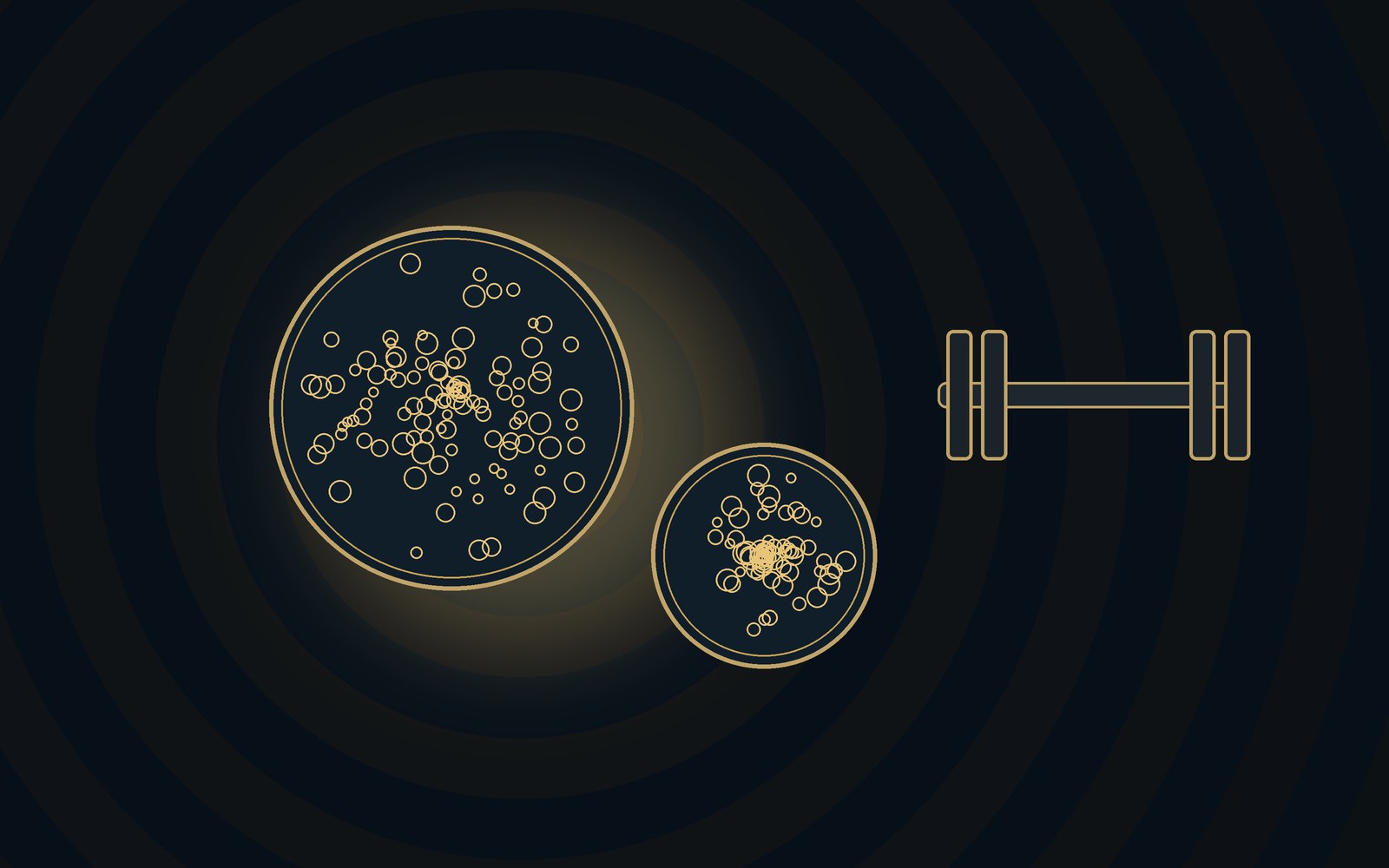
In a McMaster University study, 12 young men trained each arm on its own for 15 weeks. On "low hormone" days, they did arm curls and went home.
On "high hormone" days, they did the same curls, then a brutal leg session. That flooded their blood with growth hormone, IGF-1 and testosterone right after the workout.
The result? Both arms grew about the same, around 10 to 12% bigger, and got about equally stronger. The hormone flood didn't add anything you could measure.
The muscle cared about the work it did, not the chemistry floating past it.
What has receipts, from that study, a big protein review, a sleep trial and US activity guidelines:
Lift something challenging at least two days a week. That's the federal guideline for adults.
Eat enough protein. Across 49 trials, extra protein added modest size and strength on top of training, and the benefit leveled off past a point.
Sleep. In one study, a single sleepless night cut the next day's muscle-building rate by about 18%.
Give it time. That arm study ran for nearly four months.
Not glamorous. Neither is a squat rack, and it works anyway.
So what is IGF-1 LR3?
Start with IGF-1, short for insulin-like growth factor 1. Your liver makes it when growth hormone knocks, and it tells cells to grow and repair.
Here's the catch: most of your IGF-1 travels around clipped to "binding proteins." Think of them as leashes. They keep the signal from running off and growing everything in sight.
In the early 1990s, Australian government scientists in Adelaide built a version that slips the leash. They added a 13-piece tail to the front and swapped one building block. They called it Long R3 IGF-I. In dishes of rat muscle cells, it outperformed the natural hormone.
Did it work in animals?
Sort of. Rats on a steroid that breaks down muscle lost less weight on LR3, and it was about two and a half times as potent as regular IGF-1.
But the same team found the gut was one of the most sensitive targets. In those rats, gut weight jumped by up to 45%.
That's the thing about a growth signal off the leash. It doesn't pick your biceps. It grows whatever is listening. And it's rats, from 1992.
Has anyone tested it in people?
No. When we searched PubMed this week, we found no clinical trial of IGF-1 LR3 in humans.
Its real day job is biomanufacturing. Companies add it to the nutrient broth that keeps hamster ovary cells pumping out drugs in giant steel tanks. The company that makes that cell-culture version says plainly that it's "not approved or permitted for use in any human application."
IGF-1 LR3's résumé says "feeds hamster cells in a tank," not "rebuilds quads."
The closest human evidence uses plain IGF-1, and it's not encouraging for gym goals. In a 2015 UK trial, 56 recreational athletes took IGF-1 bundled with its own binding protein for 28 days. Aerobic fitness rose a bit. Muscle and body fat didn't budge.
Plain IGF-1 is also an approved medicine, for kids with a rare growth disorder. Its FDA label warns about severe low blood sugar that has caused seizures. It also notes tumor reports, seen more often when IGF-1 levels ran above normal, though nobody knows if the drug caused them.
Sports anti-doping rules ban IGF-1 and its look-alikes at all times.
Taking the leash off a growth signal doesn't teach it where to go.
Literature, not lore.
If you remember one thing…
In a real training study, the arm without the hormone spike grew just as much, because load, protein, sleep and time do the building. IGF-1 LR3 is a lab-dish workhorse with rat data and zero human trials.
Everything Inspired Labs carries is Research Use Only: lab material, not a recovery aid, and not for your body. Nothing here is medical advice.
Sources
- 01Elevations in ostensibly anabolic hormones with resistance exercise enhance neither training-induced muscle hypertrophy nor strength of the elbow flexors — West DW, Burd NA, Tang JE, et al (2010). J Appl Physiol.
Human-rct (12 healthy young men, within-subject design, each arm trained 15 weeks under a low- or high-hormone condition; GH, IGF-1 and testosterone rose only after the high-hormone protocol; muscle cross-sectional area up 12% vs 10% with no difference between conditions; strength gains not different; McMaster University).
- 02A systematic review, meta-analysis and meta-regression of the effect of protein supplementation on resistance training-induced gains in muscle mass and strength in healthy adults — Morton RW, Murphy KT, McKellar SR, et al (2018). Br J Sports Med.
Human-rct meta-analysis (49 RCTs, 1,863 participants; protein supplementation modestly increased strength and fat-free mass during training of 6+ weeks; no further gains beyond a total-intake plateau; senior author reports National Dairy Council support).
- 03The effect of acute sleep deprivation on skeletal muscle protein synthesis and the hormonal environment — Lamon S, Morabito A, Arentson-Lantz E, et al (2021). Physiol Rep.
Human-rct (randomized crossover, 13 healthy young adults; one night of total sleep deprivation reduced postprandial muscle protein synthesis by 18%, raised cortisol 21%, lowered testosterone 24%).
- 04US Department of Health and Human Services (2018). Physical Activity Guidelines for Americans, 2nd edition.
Guidance (adults should also do muscle-strengthening activities of moderate or greater intensity involving all major muscle groups on 2 or more days a week).
- 05Novel recombinant fusion protein analogues of insulin-like growth factor (IGF)-I indicate the relative importance of IGF-binding protein and receptor binding for enhanced biological potency — Francis GL, Ross M, Ballard FJ, et al (1992). J Mol Endocrinol.
Preclinical (CSIRO Adelaide; Long [Arg3]-IGF-I built with an N-terminal extension and Glu3→Arg; more potent than IGF-I in L6 rat myoblasts and IGFBP-secreting cell lines; potency tied to reduced IGFBP interaction).
- 06Insulin-like growth factor-I (IGF-I) and especially IGF-I variants are anabolic in dexamethasone-treated rats — Tomas FM, Knowles SE, Owens PC, et al (1992). Biochem J.
Preclinical (dexamethasone-treated rats, 7 days by pump; LR3IGF-I about 2.5-fold more potent than IGF-I on body weight and nitrogen retention; IGF peptides raised gut weight by up to 45%).
- 07Insulin-like growth factor-I and its N-terminal modified analogues induce marked gut growth in dexamethasone-treated rats — Read LC, Tomas FM, Howarth GS, et al (1992). J Endocrinol.
Preclinical (gut "one of the most sensitive IGF-I target tissues"; analogues including LR3IGF-I "consistently severalfold more potent").
- 08LONG® R³ IGF-I Cell Culture Supplement (product page) and LONG® R³ IGF-I FAQ — Repligen (2026). Repligen (Accessed Oct 18, 2026).
Manufacturer statement ("specifically engineered for the enhancement of cell culture performance"; "not approved or permitted for use in any human application"; supplied "expressly for use in cell culture supplementation or for other research purposes").
- 09The effects of recombinant human insulin-like growth factor-I/insulin-like growth factor binding protein-3 administration on body composition and physical fitness in recreational athletes — Guha N, Nevitt SP, Francis M, et al (2015). J Clin Endocrinol Metab.
Human-rct (56 recreational athletes, randomized, double-blind, placebo-controlled, 28 days of rhIGF-I/rhIGFBP-3; no significant change in fat mass or lean mass; VO2 max up about 7% in pooled treated groups; Southampton). Note: this is native IGF-1 complex, not LR3.
- 10INCRELEX (mecasermin) injection prescribing information, revised 07/2025 — US Food and Drug Administration (2025). US Food and Drug Administration.
Approved-drug (indicated for growth failure in pediatric patients 2+ with severe primary IGF-1 deficiency or GH gene deletion with neutralizing antibodies; "Severe hypoglycemia leading to hypoglycemic seizures has been observed"; postmarketing malignant neoplasm reports, "observed also more frequently" at higher-than-recommended doses or IGF-1 above normal ranges; relationship unknown).
- 11World Anti-Doping Agency (2026). 2026 Prohibited List.
Rule (S2.3 Growth Factors, prohibited at all times: "Insulin-like growth factor 1 (IGF-1, mecasermin) and its analogues").
Educational material for laboratory research context only. Nothing here is medical advice, a protocol for human use, or a claim that Inspired Labs products diagnose, treat, cure, or prevent disease.
Previous
Cartalax Has Only Met Cartilage in a Dish
Next
The Fat-Burning Peptide That Couldn't Beat a Dummy Pill
Continue
Your Muscle Noticed Menopause. Science Still Points at Iron.
After menopause, honestly
Your Muscle Noticed Menopause. Science Still Points at Iron.
Read brief → 3 min

Your Tendons Are Still Running on Your Teenage Collagen
Recovery, honestly
Your Tendons Are Still Running on Your Teenage Collagen
Read brief → 3 min
The Holiday Pound Is Small. It Just Never Leaves.
Weight, honestly
The Holiday Pound Is Small. It Just Never Leaves.
Read brief → 3 min