
Regulatory hype/Compounds
KPV Is Not a Compounding Green Light
Peptide feeds treat a July 2026 FDA advisory vote like the agency cleared compounding for KPV. The mouse inflammation papers are real. A green light on the 503A Bulks List is not.
Inspired Labs Editorial/Sep 29, 2026/6 sources
KPV Is Not a Compounding Green Light
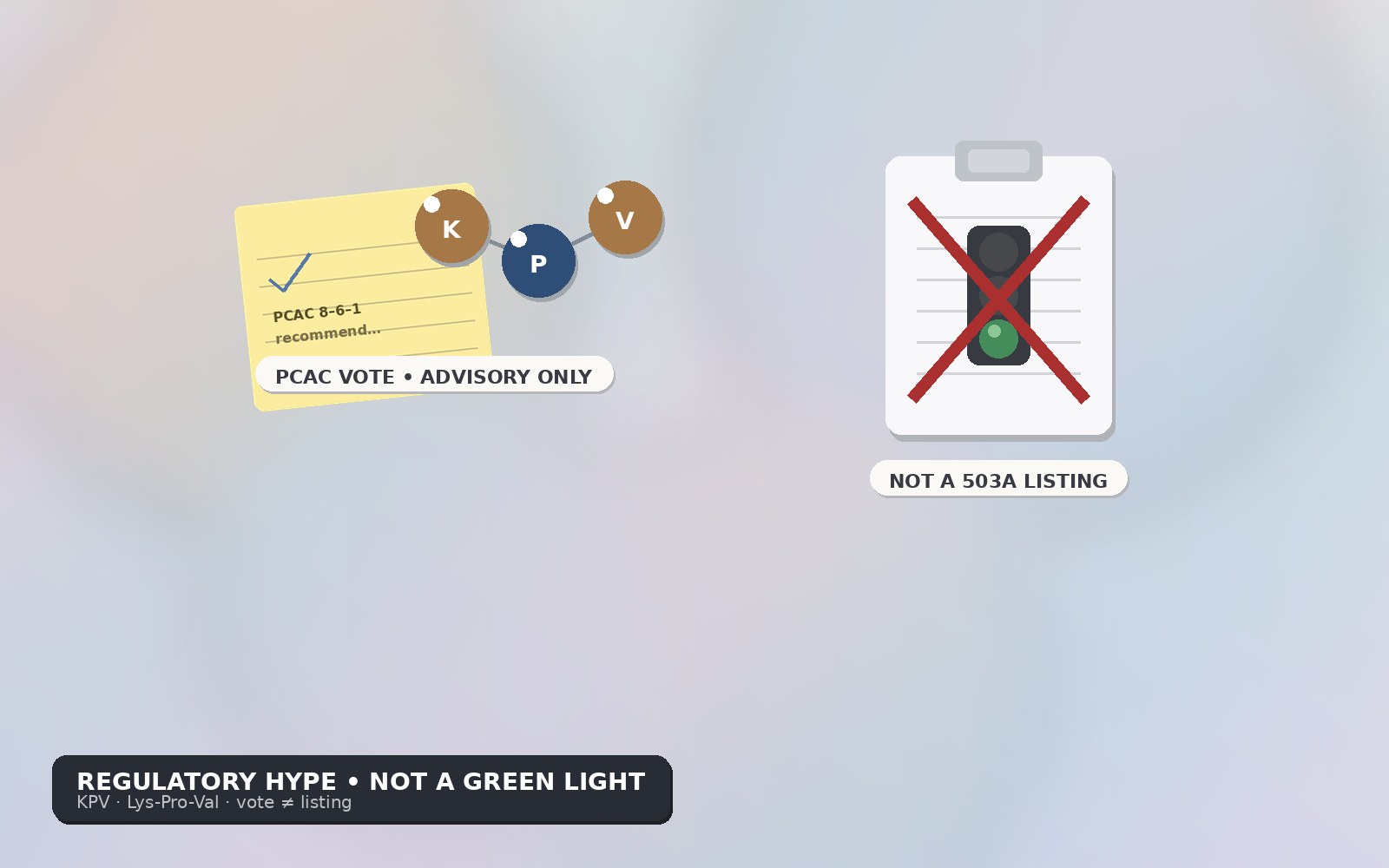
Your feed treats a committee vote like a green light. Someone screenshots “PCAC recommends KPV,” and the comments act like FDA cleared the driveway.
Here’s the thing. The mouse inflammation papers are real. The compounding green light is not.
It’s closer to a sticky note on a draft rule than a green light at the driveway. Same building. Completely different permission about what you can drive through.
Our house rule is Literature, not lore. So let’s sort the viral caption from the papers, the vote, and what still is not on the list.
Wait — what even is KPV?
It is a lab-made tripeptide. Three amino acids in a row: lysine, proline, valine. Researchers write that as Lys-Pro-Val, or KPV for short.
Those three letters are the tip of a longer hormone — α-melanocyte-stimulating hormone, or α-MSH. People shorten that to “α-MSH(11–13).” Same family tree on a slide. A much smaller tool on the bench.
If you want the bead-string basics, start with the Journal brief on peptides as short sentences.
Same hormone family. Different tool?
Yes. Related. Not Melanotan. Not Vyleesi.
Melanotan II and bremelanotide (PT-141 / Vyleesi) are longer melanocortin agonists built around receptor stories people already know — pigment, desire, labeled-product lanes. KPV is only the three-letter tip. Several labs report its anti-inflammatory signal does not need classic melanocortin-receptor agonism the way those longer peptides do.
In crystal-induced peritonitis work, KPV still reduced neutrophil pile-up even when antagonists that block Melanotan-style peptides were present. In human airway cells, it interfered with NF-κB’s p65 subunit getting imported into the nucleus. More transport story than “hit the MC4 receptor.” Lumping KPV with Melanotan is a category error, not a helpful nickname.
Three letters clipped from α-MSH do not inherit Melanotan’s receptor biography — or a compounding green light.
If you want the approved melanocortin product story, that is Vyleesi — see the live PT-141 is Vyleesi brief. For the cousin naming trap, read Melanotan II is not PT-141. If the experiment is the tripeptide itself, stay on KPV’s own file.
So what did the colitis papers actually show?
Two mouse lines are the backbone most people mean when they say “KPV and the gut.”
In DSS colitis and in a T-cell transfer colitis model, KPV was tied to earlier recovery, better weight regain, and less inflammatory infiltrate in colon tissue. Animals with a nonfunctional melanocortin-1 receptor still benefited in a DSS setting — another hint that MC1R is not the whole mechanism.
Separately, work on the peptide transporter PepT1 showed intestinal cells can take KPV up that way. In culture, KPV dampened NF-κB and MAP-kinase inflammatory signaling. Oral KPV in drinking water reduced injury signals in DSS- and TNBS-colitis mice.
Those are careful, early-stage findings. They are not a finished human IBD program. They do not turn a research vial into a disease claim.
A 2025 keratinocyte paper added a skin angle: KPV reduced fine-dust-driven stress and inflammatory cell-death markers in HaCaT cells and a 3D skin model. Useful hypothesis work. Still not a human outcome trial.
For how we grade that gap, see the live how-this-journal-grades brief. Neighboring blend context — not a blend trial — lives in the GLOW and KLOW brief (glow-is-three-literatures).
Did FDA clear compounding?
No.
On July 23, 2026, FDA’s Pharmacy Compounding Advisory Committee considered KPV free base and KPV acetate for the 503A Bulks List. The nominated framing leaned wound healing and inflammatory skin conditions. FDA’s own briefing materials proposed that neither form be included. Staff could not point to human clinical data that carried the day for them.
The committee voted 8 yes, 6 no, 1 abstain to recommend inclusion of both forms. That is advice. It is not notice-and-comment rulemaking. It is not a stamped listing.
As of September 2026, KPV is still not on the 503A Bulks List. It has no FDA-approved indication. Treating the vote like “FDA approved KPV for compounding” is exactly the sticky-note-as-green-light move this Journal exists to refuse.
Then why do feeds still push the green-light caption?
Because “committee recommends” screenshots travel farther than “advisory only, staff proposed against, not yet listed.”
Compounding law is boring on purpose. Feeds prefer a traffic-light emoji. Once the caption collapses recommendation into clearance, the driveway looks open while the formal list stays closed. That is how sticky notes get sold as green lights.
The one thing to remember
KPV is Lys-Pro-Val — three letters from the tip of α-MSH. Real mouse inflammation papers. A July 2026 PCAC recommendation that is not a 503A Bulks listing and not an approved drug. Related to Melanotan’s family tree. Not Melanotan. Not Vyleesi. Not a compounding green light.
Sources
- 01Melanocortin-derived tripeptide KPV has anti-inflammatory potential in murine models of inflammatory bowel disease — Kannengiesser K, et al. (2008). Inflammatory Bowel Diseases.
PMID 18092346. DSS and transfer colitis; reduced infiltrate/MPO; benefit reported in MC1R-deficient mice.
- 02PepT1-mediated tripeptide KPV uptake reduces intestinal inflammation — Dalmasso G, et al. (2008). Gastroenterology.
PMID 18061177. PepT1 uptake; NF-κB/MAPK dampening; oral KPV in DSS/TNBS mice.
- 03Dissection of the anti-inflammatory effect of the core and C-terminal (KPV) α-melanocyte-stimulating hormone peptides — Getting SJ, et al. (2003). Journal of Pharmacology and Experimental Therapeutics.
PMID 12750433. KPV anti-migratory effect distinct from core melanocortin peptides; unlikely classic MC-receptor agonism.
- 04Inhibition of cellular and systemic inflammation cues in human bronchial epithelial cells by melanocortin-related peptides — Land SC, et al. (2012). International Journal of Physiology, Pathophysiology and Pharmacology.
PMID 22837805. KPV interferes with p65RelA nuclear import in airway epithelium.
- 05Lysine-Proline-Valine peptide mitigates fine dust-induced keratinocyte apoptosis and inflammation — Sung J, Ju SY, Park S, Jung WK, Je JY, Lee SJ (2025). Tissue & Cell.
PMID 40073467. HaCaT / 3D skin model versus PM10 — early lab.
- 06July 23–24, 2026 Meeting of the Pharmacy Compounding Advisory Committee — meeting materials — U.S. Food and Drug Administration (2026). U.S. Food and Drug Administration.
PCAC considered KPV free base and acetate for the 503A Bulks List. Contemporaneous reporting: 8–6–1 recommendation; FDA staff had proposed against inclusion. Advisory vote ≠ 503A listing ≠ drug approval. As of Sep 2026, KPV remains off the 503A Bulks List.
Educational material for laboratory research context only. Nothing here is medical advice, a protocol for human use, or a claim that Inspired Labs products diagnose, treat, cure, or prevent disease.
Continue

Your Muscle Noticed Menopause. Science Still Points at Iron.
After menopause, honestly
Your Muscle Noticed Menopause. Science Still Points at Iron.
Read brief → 3 min

Your Tendons Are Still Running on Your Teenage Collagen
Recovery, honestly
Your Tendons Are Still Running on Your Teenage Collagen
Read brief → 3 min

The Holiday Pound Is Small. It Just Never Leaves.
Weight, honestly
The Holiday Pound Is Small. It Just Never Leaves.
Read brief → 3 min