Naming trap/Compounds
Oxytocin Is Not a Bonding Protocol
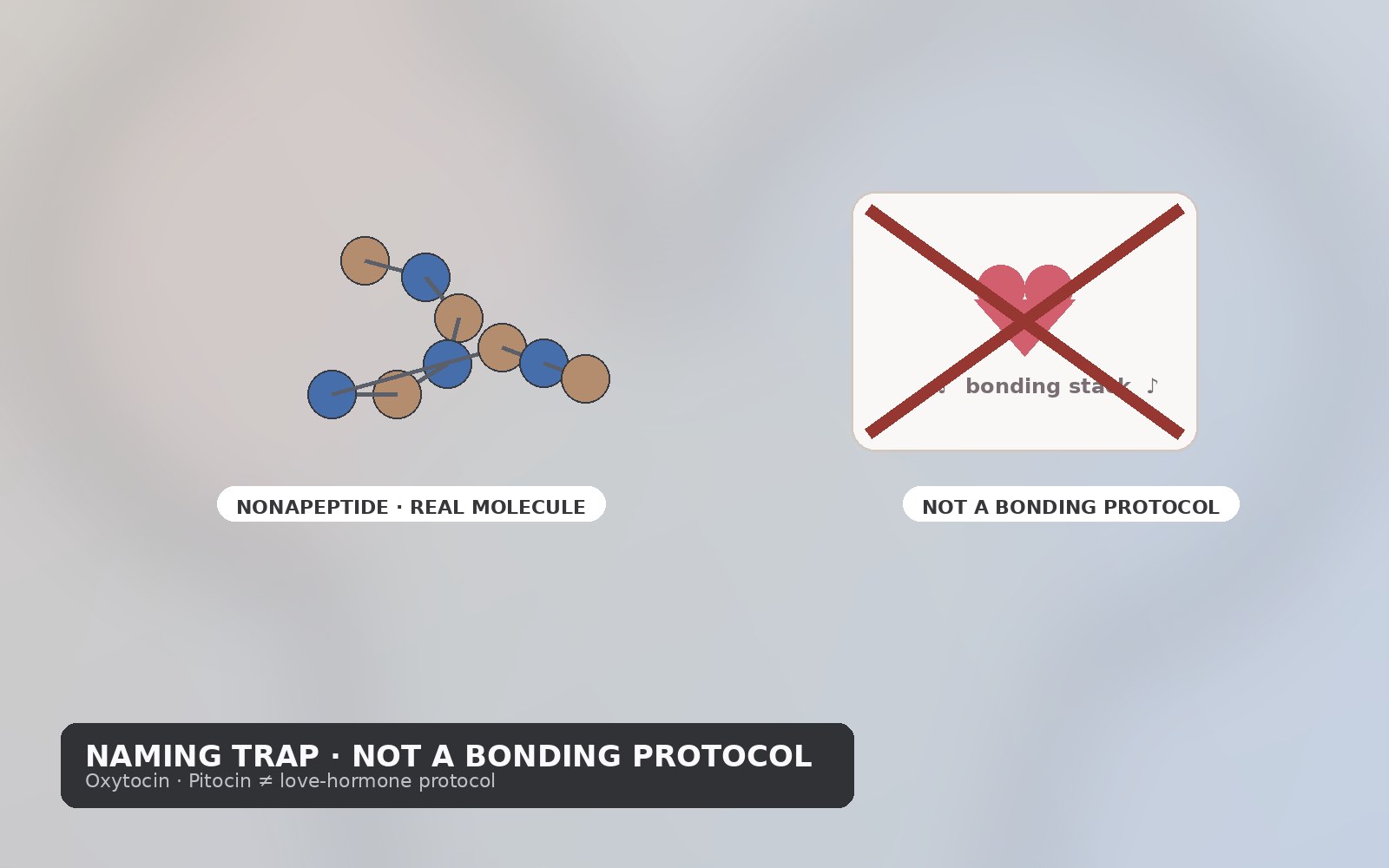
Feeds call oxytocin the “love hormone” and treat a research vial like a bonding protocol. Oxytocin is a real nine-amino-acid neuropeptide — and a hospital drug with a narrow obstetric label (Pitocin). The emoji nickname and the product identity are not the same file.
Inspired Labs Editorial/Oct 1, 2026/7 sources
Oxytocin Is Not a Bonding Protocol
Someone texts you a heart emoji and a peptide name. The caption says “bonding stack.” The comments treat oxytocin like a relationship app with a syringe icon.
Here‘s the thing. Oxytocin is a real molecule with a real hospital résumé. The bonding-protocol sticker is marketing cosplay.
It‘s closer to filing a wedding playlist next to a labor-and-delivery IV bag because both folders say “oxytocin.” Same word on the tab. Completely different rooms.
Our house rule is Literature, not lore. So let‘s sort the nine beads, the obstetric label, and the research-vial story before the nickname does it for you.
Wait — is oxytocin even a peptide?
Yes.
Oxytocin is a nonapeptide — nine amino acids with a little disulfide “ring” and a short tail. Think a tiny bracelet of beads. Native oxytocin is made in the hypothalamus and released from the posterior pituitary. Vasopressin is the near-twin that differs by two beads. If you want the bead-string basics, start with the Journal brief on peptides as short sentences.
So far, so ordinary. The confusion starts when “peptide” slides into “protocol,” and “protocol” slides into “love.”
So is it really the love hormone?
That‘s the nickname that ate the literature.
Researchers have studied oxytocin in maternal behavior, pair bonding in some animals, lactation, and social cues. Those lanes are real research topics. They are not a guarantee that a spray or a vial will rewrite your attachment style.
Sue Carter‘s 2021 essay walks the “love hormone” metaphor carefully and still leaves myths and gaps on the table. A 2022 Philosophical Transactions review asks whether oxytocin is even a clean “social peptide” and finds the best-cited evidence thinner than the headlines. Leng and Ludwig‘s 2016 paper on intranasal oxytocin is blunter: lots of wish, weak brain-delivery math, and peripheral levels that shoot past anything physiological.
If you‘ve been googling bonding stacks, you‘ve probably seen the emoji version. Here‘s the kindly fix: context matters, person matters, and a catchy nickname is not a trial design.
Think of endogenous oxytocin as a house intercom that rings for birth, milk, and some social cues. A research vial or a nasal spray in a caption is not that intercom with better branding. Same name on the doorbell. Different building.
What about the hospital drug — is that the same story?
Different file. Same amino-acid name.
Synthetic oxytocin sold as Pitocin is FDA-labeled for obstetric jobs: help start or strengthen contractions when that‘s medically indicated, and help the uterus contract after delivery to control bleeding. It is a monitored hospital medicine, not a couples retreat.
That labeled lane is why evidence chips can honestly say “approved drug” — with the asterisk that this is different product context. A research lyophilized lot is not Pitocin. Pitocin is not a bonding protocol either.
You‘ve seen this sibling move before: the live PT-141 is Vyleesi brief keeps the research name and the labeled product in separate drawers. Same discipline here.
A nine-bead hormone can sit in a labor ward and still refuse to be your relationship coach.
Did human studies ever look at “social” oxytocin?
Yes — mostly as intranasal add-ons in psychiatry and autism research. High-level only. Not a protocol.
A 2024 Frontiers in Psychiatry meta-analysis of autism trials found no clean overall win on social scores in the first pass. Some dose-exploration signals show up in secondary cuts. That is “interesting and messy,” not “problem solved.”
A 2024 systematic review asked whether intranasal oxytocin plus psychotherapy helps mental disorders. The authors saw some signal on depressive symptoms in a small meta-slice, and little clean movement on core psychiatric symptoms or social functioning. Heterogeneous trials. Modest samples. Open questions.
For how we grade that gap, see the live how-this-journal-grades brief.
Why do feeds still sell the bonding story?
Because “love hormone” fits in a caption and “context-dependent neuromodulator with messy translation” does not.
The research hallway is social cognition, stress, childbirth, and lactation. The product mash is a research vial wearing a wedding hashtag. Search engines and clinic menus love hallway words. Product identity does not.
If you hold a research lot, identity paperwork beats vibes. Start with the live COA-is-not-a-vibe brief.
The one thing to remember
Oxytocin is a nine-amino-acid neuropeptide with a real obstetric drug lane (Pitocin) and a noisy social-behavior literature that does not cash out as a bonding protocol. Human intranasal trials exist; results are mixed and context-heavy. The emoji nickname is not a diploma.
Sources
- 01Intranasal Oxytocin: Myths and Delusions — Leng G, Ludwig M (2016). Biological Psychiatry.
PMID 26049207. Critique of intranasal delivery assumptions, peripheral overshoot, measurement problems, and publication practices in the social-oxytocin wave.
- 02Oxytocin and love: Myths, metaphors and mysteries — Carter CS (2021). Comprehensive Psychoneuroendocrinology.
PMID 35755926. PMC 9216351. Essay on the “love hormone” metaphor, oxytocin–vasopressin kinship (nine amino acids; two-residue contrast), and remaining myths/gaps.
- 03Oxytocin—a social peptide? Deconstructing the evidence (2022). Philosophical Transactions of the Royal Society B.
PMC 9272144. Critical review arguing that highly cited evidence for a clean “social neuropeptide” claim is weaker than popular framing suggests.
- 04Could intranasal oxytocin enhance the effects of psychotherapy in individuals with mental disorders? A systematic review and meta-analysis — Pérez-Rodríguez et al. (2024). PubMed.
PMID 39366103. Thirteen RCTs reviewed; small meta-slice suggested depressive-symptom signal with combined treatment; limited effects on psychiatric symptoms and social functioning; heterogeneity and small samples noted.
- 05Optimal dose of oxytocin to improve social impairments and repetitive behaviors in autism spectrum disorders: meta-analysis and dose–response meta-analysis of randomized controlled trials (2024). Frontiers in Psychiatry.
Twelve RCTs / 498 ASD participants; overall social-score effect not significant on primary pass; exploratory higher-dose cuts reported — not a settled clinical recipe.
- 06Pitocin (Oxytocin Injection, USP) Synthetic — Prescribing Information — Par Pharmaceutical / FDA label (2021). U.S. Food and Drug Administration.
May 2021 revision. Nonapeptide formula C43H66N12O12S2 (~1007 Da); labeled for medically indicated labor induction/augmentation and postpartum uterine contraction / hemorrhage control — hospital product context, not a research-vial diploma.
- 07PubChem compound record for oxytocin — PubChem (2026). PubChem.
CID 439302. Identity check: cyclic nonapeptide; disulfide bridge; contrast with vasopressin. Structural neighbor talk, not product equivalence to Pitocin or to any research lot‘s COA.
Educational material for laboratory research context only. Nothing here is medical advice, a protocol for human use, or a claim that Inspired Labs products diagnose, treat, cure, or prevent disease.
Continue
Your Muscle Noticed Menopause. Science Still Points at Iron.
After menopause, honestly
Your Muscle Noticed Menopause. Science Still Points at Iron.
Read brief → 3 min

Your Tendons Are Still Running on Your Teenage Collagen
Recovery, honestly
Your Tendons Are Still Running on Your Teenage Collagen
Read brief → 3 min

The Holiday Pound Is Small. It Just Never Leaves.
Weight, honestly
The Holiday Pound Is Small. It Just Never Leaves.
Read brief → 3 min