
Naming trap/Compounds
DSIP Is Not a Sleep Protocol
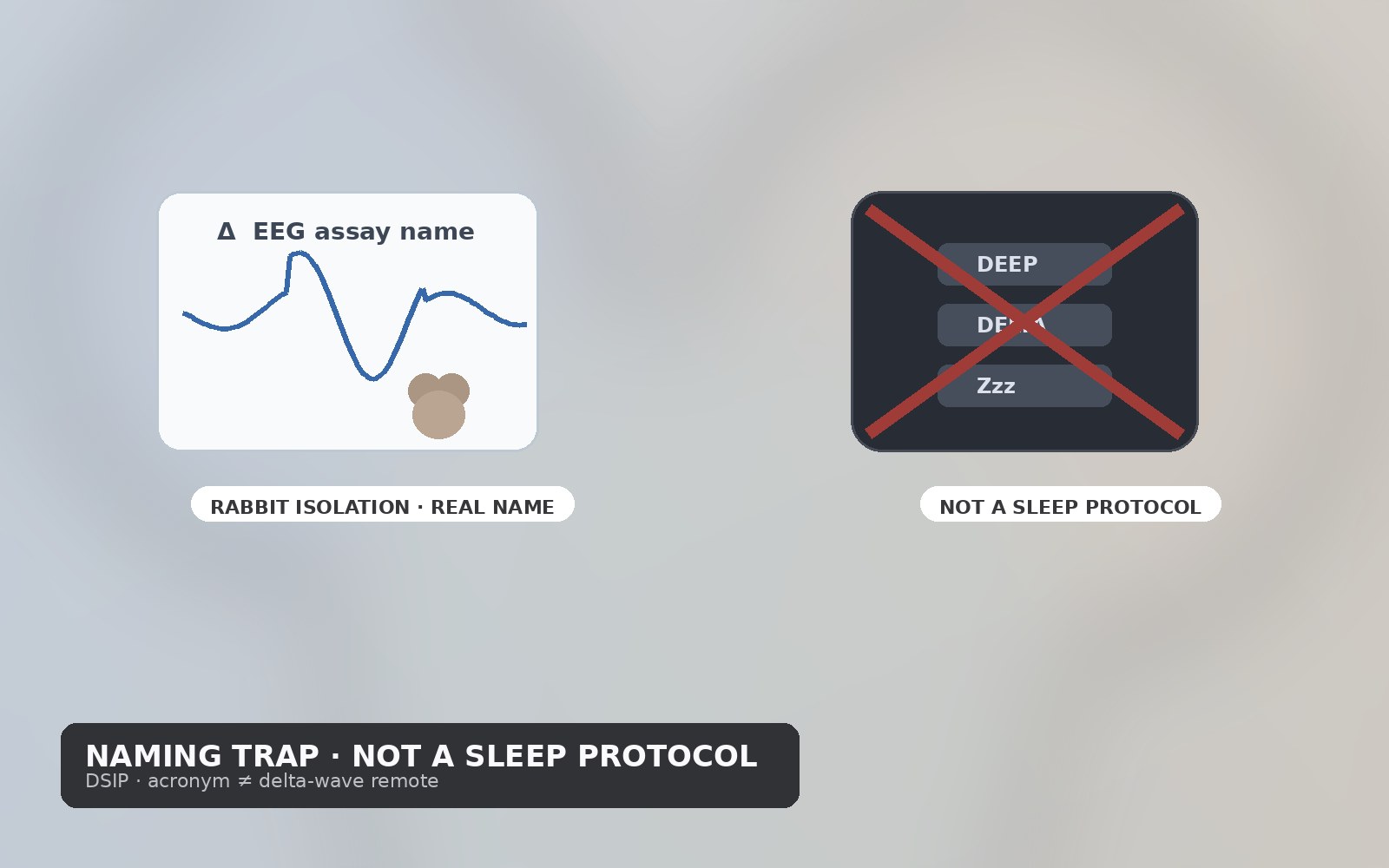
Forums treat DSIP like a delta-wave remote control because the name says “Delta Sleep-Inducing Peptide.” The rabbit isolation story is real. The later human insomnia trials were small, mixed, and often underwhelming — and a 2006 review still called the sleep-factor claim a poorly documented riddle.
Inspired Labs Editorial/Oct 1, 2026/6 sources
DSIP Is Not a Sleep Protocol
You are staring at another “deep sleep peptide” thread. The caption says DSIP. Someone swears it flips your brain into delta waves like a dimmer switch.
Here‘s the thing. The name is a promise. The papers are a shrug with footnotes.
It‘s closer to buying a song titled “Deep Sleep” and finding out the chorus is mostly elevator music in stage 2. Catchy title. Different playlist than the cover art sold you.
Our house rule is Literature, not lore. So let‘s sort the rabbit discovery, the human insomnia nights, and the open riddle before the nickname does it for you.
Wait — what is DSIP, in plain English?
DSIP stands for Delta Sleep-Inducing Peptide.
It is a nine-amino-acid chain isolated in the late 1970s from the cerebral venous blood of sleeping rabbits by the Schoenenberger–Monnier group in Basel. Researchers tracked a “delta-EEG enhancing” signal, sequenced a nonapeptide, and gave it a name that still does marketing work decades later.
A peptide is a short string of amino acids — beads on a string. That part is ordinary. If you want the class basics, see the Journal brief on peptides as short sentences.
The trap is the first word: delta. It sounds like a guaranteed slow-wave upgrade. Names are not sleep studies.
Did the discovery paper settle sleep biology?
It settled a chemistry chapter, not a bedtime franchise.
The isolation and characterization work showed a specific nonapeptide with activity in the assay the group used. That is how a lot of neuropeptide stories start: dialysate, chromatography, a sequence, a synthetic twin.
What it did not do is hand the field a finished gene, a finished precursor map, and a finished receptor with a bow on it. Those missing pieces matter later.
So what did the human insomnia trials actually show?
Small. Old. Mixed. Worth reading without the forum soundtrack.
In 1987, Monti and colleagues ran a short double-blind crossover in chronic insomniacs. Some sleep-structure numbers moved in DSIP nights, but the authors judged the sleep improvement of little clinical significance. Slow-wave sleep — the “delta” the name brags about — was not the clean winner people assume from the acronym.
In 1992, Bes and colleagues tested DSIP against placebo across laboratory nights in chronic insomnia. Objective sleep efficiency and latency looked a bit better under DSIP. The authors still concluded short-term treatment was not likely to be of major therapeutic benefit. They even flagged that some “wins” might track incidental placebo-group noise.
An earlier Schneider-Helmert report in severe chronic insomnia sounded more upbeat on night sleep and daytime function. That paper is part of the record. It does not erase the cooler later reads. When the folder has both a hopeful write-up and “little clinical significance,” you do not get to keep only the hopeful page.
A peptide can be named for delta sleep and still fail to own delta sleep in the better-controlled nights.
Why do reviews still call it a riddle?
Because the biology file never fully closed.
Kovalzon and Strekalova‘s 2006 mini-review in the Journal of Neurochemistry titled the problem bluntly: DSIP is “a still unresolved riddle.” They argue the sleep-factor hypothesis is extremely poorly documented and still weak — in part because no DSIP gene, protein, or related receptor had been isolated. They even float that some “DSIP-like” immunoreactivity and activity might belong to related peptides that are not DSIP itself.
That is not internet snark. That is a peer-reviewed shrug with a hypothesis attached.
For how we grade thin, mixed, or unresolved files, see the live how-this-journal-grades brief.
Why does the lore still travel?
Because the acronym does free advertising.
“Delta Sleep-Inducing Peptide” fits in a catalog blurb and a sleep-hack thread. “Nine beads from sleeping rabbits; human trials mixed; receptor still missing” does not. Forums collapse a discovery name into a night routine. Search engines reward the collapse.
If you are sorting identity paperwork for any research material you actually hold, start with the live COA-is-not-a-vibe brief. DSIP is not on our shelf — more on that in a second — but the same rule applies everywhere: paperwork over nicknames.
The one thing to remember
DSIP is a nine-amino-acid peptide named for a delta-sleep story from rabbit isolation work. Small human insomnia trials exist; several careful reads found weak or clinically modest signals, and slow-wave sleep did not become a clean branded feature. A 2006 review still treated the sleep-factor claim as poorly documented. The acronym is not a protocol.
Sources
- 01A naturally occurring delta-EEG enhancing nonapeptide in rabbits. X. Final isolation, characterization and activity test — Schoenenberger GA, et al. (1977). Pflügers Archiv.
PMID 560681. Foundational isolation/characterization of the rabbit-derived nonapeptide later known as DSIP; assay-linked delta-EEG framing that seeded the name.
- 02Delta sleep-inducing peptide (DSIP): a still unresolved riddle — Kovalzon VM, Strekalova TV (2006). Journal of Neurochemistry.
PMID 16539679. Mini-review: sleep-factor hypothesis poorly documented; no isolated DSIP gene/protein/receptor; proposes possible DSIP-like peptide(s) behind some immunoreactivity/activity.
- 03Effects of Delta Sleep-Inducing Peptide on Sleep of Chronic Insomniac Patients — Bes F, Hofman W, Schuur J, Van Boxtel CJ (1992). Neuropsychobiology.
PMID 1299794. Double-blind matched-pairs insomnia study; some objective efficiency/latency signals; authors conclude short-term DSIP unlikely of major therapeutic benefit; note possible placebo-group artefact.
- 04Study of delta sleep-inducing peptide efficacy in improving sleep on short-term administration to chronic insomniacs — Monti JM, et al. (1987). International Journal of Clinical Pharmacology Research.
PMID 3583493. Double-blind crossover; authors judge sleep improvement of little clinical significance; slow-wave sleep not a clean DSIP win.
- 05Effects of Delta-Sleep-Inducing Peptide on 24-Hour Sleep-Wake Behaviour in Severe Chronic Insomnia — Schneider-Helmert D (1987). European Neurology.
PMID 3622582. Placebo-controlled intermediate-term report in chronic insomniacs with more positive sleep/daytime readouts — included to show the split in the human folder, not to override later cautious conclusions.
- 06Characterization of a delta-electroencephalogram (-sleep)-inducing peptide (1978). PubMed Central.
Related early characterization literature (PMC 430668). Structural/activity companion to the isolation story; supports “named for an EEG assay,” not “proven human delta remote control.”
Educational material for laboratory research context only. Nothing here is medical advice, a protocol for human use, or a claim that Inspired Labs products diagnose, treat, cure, or prevent disease.
Continue
Your Muscle Noticed Menopause. Science Still Points at Iron.
After menopause, honestly
Your Muscle Noticed Menopause. Science Still Points at Iron.
Read brief → 3 min

Your Tendons Are Still Running on Your Teenage Collagen
Recovery, honestly
Your Tendons Are Still Running on Your Teenage Collagen
Read brief → 3 min
The Holiday Pound Is Small. It Just Never Leaves.
Weight, honestly
The Holiday Pound Is Small. It Just Never Leaves.
Read brief → 3 min