
Naming trap/Compounds
Peptides for Women Is Not a Protocol
Feeds sell “peptides for women” and “premenopause stacks” like one pink protocol. Midlife body-composition change is a real research story. A single vial menu is not. Different molecules, different evidence grades, different labeled-product fences — and a lot of hallway talk.
Inspired Labs Editorial/Oct 1, 2026/6 sources
Peptides for Women Is Not a Protocol
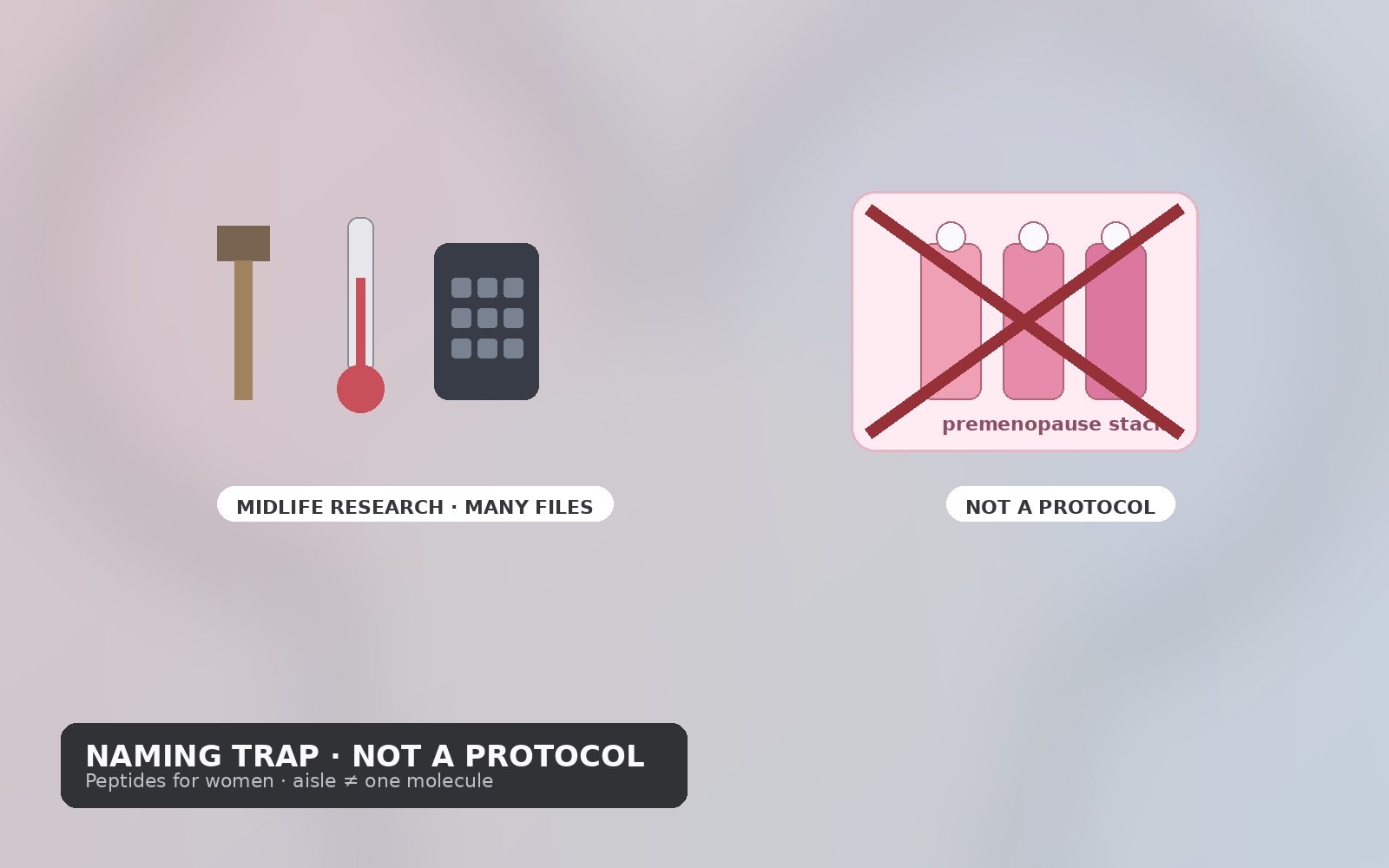
Your group chat drops another “peptides for women” screenshot. The caption says premenopause stack. Three vials, one pink font, zero footnotes.
Here‘s the thing. Midlife change is a real biology chapter. A matching trio of research labels is not a chapter summary.
It‘s closer to buying a “women‘s toolkit” at the hardware store and finding a hammer, a thermometer, and a calculator shrink-wrapped together because the aisle sign said wellness. Shared shelf talk. Completely different jobs.
Our house rule is Literature, not lore. So let‘s sort what researchers actually study around the menopause transition from the protocol cosplay before the nickname does it for you.
Wait — is “peptides for women” even a category?
Not as one molecule class.
A peptide is a short chain of amino acids — beads on a string. That definition does not care about your birthday. If you want the basics, start with the Journal brief on peptides as short sentences.
What people mean by the caption is usually a mash of very different files: incretin drugs people recognize from weight-loss headlines, GH-axis research tools, melanocortin desire drugs, kisspeptin signaling work, and “healing peptide” forum favorites. Same pink marketing banner. Different evidence grades.
If you‘ve been googling premenopause peptides, you‘ve probably seen the mash. Here‘s the kindly fix: ask which molecule, which population, and which paper — not which aesthetic.
So what actually changes in midlife that researchers measure?
Body composition, for one.
The Study of Women‘s Health Across the Nation (SWAN) followed women through the menopause transition with careful timing around the final menstrual period. Fat gain sped up and lean mass drifted down across that window, even when bathroom-scale weight did not tell a simple acceleration story. That is a longitudinal research finding about midlife physiology. It is not a shopping list.
When a caption jumps from “fat redistributes in midlife” to “buy these three vials,” it skipped the part where evidence has to name a molecule.
Do GLP-1 drugs count as “women‘s peptides”?
They are peptides in chemistry class. They are mostly labeled medicines in the real world.
GLP-1 receptor agonists sit in a huge obesity and diabetes literature. Menopause-specific write-ups are still catching up. A 2026 scoping review on GLP-1 medicines in menopausal and postmenopausal women found signals on weight and central adiposity in the papers it surveyed, flagged thinner evidence on vasomotor symptoms and longer-term markers, and asked for larger, better studies — including bone questions.
A 2024 retrospective look at postmenopausal women on semaglutide reported greater average weight loss among those also using menopause hormone therapy than among those not on HT. Association, not a branded “women‘s GLP stack.” Confounders matter. Bigger trials still wanted.
For the broad incretin hallway we already cover, see the live GLP-1, the incretin everyone knows brief. A labeled pen is not a research vial cosplay kit.
Midlife metabolic change can be real without turning every peptide into a pink protocol.
What about desire drugs and “female peptides”?
Different drawer. Read the label fence.
Bremelanotide — brand Vyleesi — is FDA-labeled for acquired, generalized hypoactive sexual desire disorder in premenopausal women. The label says it is not indicated for postmenopausal women or for men, and not for performance enhancement. That is a product identity fact, not a vibe.
So when a feed files PT-141 next to a “perimenopause stack,” it is often borrowing a premenopausal labeled lane and pasting it onto a different life chapter. We already walked that naming trap in the live PT-141 is Vyleesi brief.
Kisspeptin research is another neighbor — a reproductive-axis signaling peptide with early human work, including a randomized crossover study in premenopausal women with HSDD that watched brain responses to erotic and facial stimuli. Interesting signaling science. Not a midlife stack diploma. Not a substitute for reading which population sat in the scanner.
And the GH-axis / “healing” vials in the same screenshot?
Shared hallway talk. Separate folders.
CJC-family tools and related GH-axis research materials show up in clinic menus aiming at body composition and recovery chatter. That conversation has its own brief: the live CJC-1295 + Ipamorelin two-knobs brief. Tesamorelin has a labeled product story for a narrow HIV-lipodystrophy indication — see the live Tesamorelin is Egrifta brief — which is not “women‘s midlife peptide therapy” branding.
BPC-157 and similar “healing” names lean heavily on animal literature. Our house read is already on the shelf: the live BPC-157 animal-literature brief. Extrapolating mouse tendons into a premenopause protocol is lore with good SEO.
For how we grade those gaps, see the live how-this-journal-grades brief.
The one thing to remember
“Peptides for women” is a marketing aisle, not a molecule. Midlife body-composition change has real longitudinal research behind it. GLP-1 medicines have growing menopause-adjacent papers and still need clearer, larger midlife-specific files. Desire-drug labels can be population-fenced (premenopausal vs not). GH-axis and “healing” names bring their own evidence grades. None of that adds up to a pink three-vial protocol.
Sources
- 01Changes in body composition and weight during the menopause transition — Greendale GA, Sternfeld B, Huang MH, et al. (2019). JCI Insight.
SWAN cohort DXA trajectories around the final menstrual period: accelerated fat gain and lean-mass loss during the menopause transition; weight trajectory did not simply mirror that acceleration story.
- 02Glucagon-Like Peptide-1 Receptor Agonists (GLP-1RAs) for Obesity and Symptoms in Menopause: A Review (2026). PubMed.
PMID 41704988. PMC 12908505. Scoping review of GLP-1 medicines in menopausal/postmenopausal women: weight/central-adiposity signals in selected papers; thinner evidence on vasomotor symptoms and longer-term markers; calls for larger midlife-specific studies including bone questions.
- 03Weight loss response to semaglutide in postmenopausal women with and without hormone therapy use (2024). Menopause.
PMID 38446869. Retrospective cohort: HT use associated with greater average weight-loss response on semaglutide after adjustment attempts; authors call for larger confirmatory studies — association, not a protocol.
- 04VYLEESI (bremelanotide) injection — Prescribing Information — U.S. Food and Drug Administration (2019). U.S. Food and Drug Administration.
Initial U.S. approval 2019. Melanocortin agonist indicated for premenopausal women with acquired, generalized HSDD; limitations of use: not indicated for HSDD in postmenopausal women or in men; not indicated to enhance sexual performance.
- 05Effects of Kisspeptin Administration in Women With Hypoactive Sexual Desire Disorder: A Randomized Clinical Trial — Thurston L, et al. (2022). JAMA Network Open.
PMID 36287566. PMC 9606846. Double-masked crossover in premenopausal women with HSDD; kisspeptin modulated sexual/attraction-related brain processing markers — early human signaling evidence, not a midlife stack claim.
- 06Bremelanotide for the Treatment of Hypoactive Sexual Desire Disorder: Two Randomized Phase 3 Trials — Kingsberg SA, Clayton AH, Portman D, et al. (2019). Obstetrics & Gynecology.
PMID 31599840. Phase 3 backbone behind the labeled bremelanotide/Vyleesi premenopausal HSDD lane — product-context citation, not research-vial advice.
Educational material for laboratory research context only. Nothing here is medical advice, a protocol for human use, or a claim that Inspired Labs products diagnose, treat, cure, or prevent disease.
Continue

Your Muscle Noticed Menopause. Science Still Points at Iron.
After menopause, honestly
Your Muscle Noticed Menopause. Science Still Points at Iron.
Read brief → 3 min

Your Tendons Are Still Running on Your Teenage Collagen
Recovery, honestly
Your Tendons Are Still Running on Your Teenage Collagen
Read brief → 3 min

The Holiday Pound Is Small. It Just Never Leaves.
Weight, honestly
The Holiday Pound Is Small. It Just Never Leaves.
Read brief → 3 min