
Naming trap/Compounds
SLU-PP-332 Is Not a Research Peptide
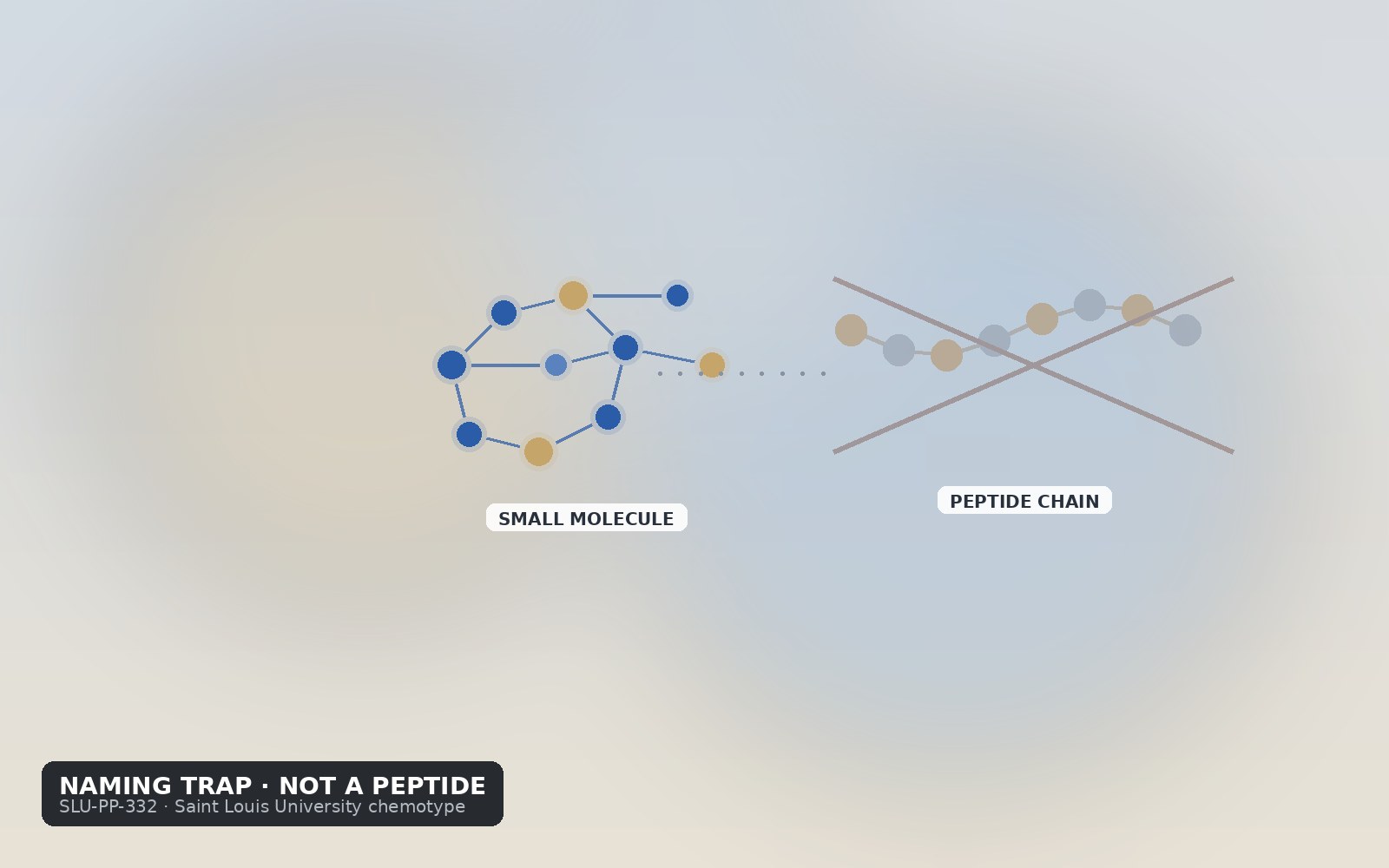
TikTok shelves “SLU-PP-332” next to research peptides and calls it an exercise mimetic. The mouse papers are real. The peptide label is not — it’s a small-molecule tool compound from a Saint Louis University chemotype, not a chain of amino acids.
Inspired Labs Editorial/Sep 26, 2026/4 sources
SLU-PP-332 Is Not a Research Peptide
Your feed serves another “exercise in a pill” clip. The caption says peptide. The comments treat it like a shortcut. Someone links a research catalog page like that’s the same shelf as MOTS-c.
Here’s the thing. The mouse work behind SLU-PP-332 is real. The peptide sticker is not.
It’s closer to filing a screwdriver in the screw aisle because both turn things. Same hardware-store neighborhood. Completely different object.
Our house rule is Literature, not lore. So let’s sort the name from the molecule before the nickname does the sorting for you.
Wait — is this even a peptide?
No.
A peptide is a short chain of amino acids, the same building blocks as the protein in your lunch. Think beads on a string. That’s the class we cover in the Journal brief on peptides as short sentences.
SLU-PP-332 is a synthetic small organic molecule — roughly the size of many ordinary pills, about 290 daltons, formula C18H14N2O2 on the public compound databases. Not a chain. Not beads. Not “basically a peptide if you squint.”
The letters come from Saint Louis University, where the Burris lab’s chemotype work started. Later write-ups also connect the group to University of Florida. Cool origin story. Still not a peptide.
If a catalog page puts it beside BPC-157 or MOTS-c, that’s shelving convenience. It’s not a chemistry diploma.
Then what does “ERR agonist” mean in plain English?
ERR stands for estrogen-related receptors. Three cousins: ERRα, ERRβ, and ERRγ. They’re orphan nuclear receptors — cellular switches that help run energy and muscle programs when your body is working hard.
“Related” is the tricky word. They are not the same thing as estrogen hormone therapy. Same family name on the mailbox. Different house. If someone hears “estrogen-related” and pictures a hormone clinic, they’ve already left the paper.
SLU-PP-332 is described as a pan-ERR agonist, strongest at ERRα. In lab language, that means it turns those switches on so researchers can watch what happens next. Tool compound energy. Not a gym playlist labeled “protein” when the bottle is just caffeine.
So what did the mouse papers actually show?
In 2023, Billon and colleagues published in ACS Chemical Biology. In mice, the compound nudged oxidative muscle-fiber markers and boosted treadmill endurance. University of Florida’s public summary rounds the normal-weight mouse story as about 70% longer and about 45% further than untreated mice. That’s animal data with a stopwatch, not a human training plan.
A follow-up in the Journal of Pharmacology and Experimental Therapeutics looked at diet-induced obese and ob/ob mice. Signals showed up on energy expenditure and fat mass. Food intake didn’t have to crash for those metabolic readouts to move. Still mice. Still a tool compound doing tool-compound work.
An “exercise mimetic” headline can be real mouse biology and still fail the “research peptide” test.
Have people taken it in a trial?
Not in any published human trial we can point to as of this brief (Sep 26, 2026).
The UF news write-up from late September 2023 was clear about next steps: refine the molecule, do more animal work, then talk about human trials. That sequence is still the public story. Mouse endurance is interesting. It is not a stadium of volunteers.
If a vendor page or a forum post skips that gap, they’re selling a vibe. We’re not.
Why do catalogs shelve it with peptides?
Because the conversation neighbors are mitochondrial and metabolic — the same hallway as the live MOTS-c brief and the NNMT / 5-Amino-1MQ brief. Search engines and TikTok captions collapse “adjacent research topic” into “same shelf, same class.”
That mash-up is how you get “peptide” stickers on a molecule with no amino-acid chain. It’s also how “exercise mimetic” slides from a mouse treadmill into a shopping cart.
5-Amino-1MQ is also a small-molecule chemotype in that metabolic lane. Different target. Different story. Mentioning it here is a reading pointer, not a claim that the two are twins or that Inspired Labs is stocking SLU-PP-332.
You’ve seen this movie. Our Orforglipron brief is the sibling warning for a GLP-1 pill that isn’t a peptide vial. Same naming trap, different door.
The one thing to remember
SLU-PP-332 is a synthetic small-molecule pan-ERR agonist from a Saint Louis University chemotype. Mouse papers in 2023 reported endurance and metabolic signals. That does not make it a research peptide, an exercise schedule, or a human-trial product.
Sources
- 01Synthetic ERRα/β/γ Agonist Induces an ERRα-Dependent Acute Aerobic Exercise Response and Enhances Exercise Capacity — Billon C, et al. (2023). ACS Chemical Biology.
PMID 36988910. Mouse tool-compound study: pan-ERR agonist (strongest at ERRα); oxidative fiber markers and endurance signals in mice.
- 02A Synthetic ERR Agonist Alleviates Metabolic Syndrome — Billon C, et al. (2023). Journal of Pharmacology and Experimental Therapeutics.
PMID 37739806. PMC 10801787. Diet-induced obese / ob/ob mice: energy expenditure and fat-mass signals; no human outcomes claimed.
- 03Exercise-mimicking drug sheds weight, boosts muscle activity in mice — University of Florida News (2023). University of Florida News.
Sep 26–27, 2023. Popular summary of the Burris / SLU line of work; notes more animal refinement before human trials; rounds the ~70% longer / ~45% further normal-weight mouse endurance figures from the ACS context.
- 04SLU-PP-332 compound record — PubChem (2024). PubChem CID 5338394.
Formula C18H14N2O2; molecular weight ~290 Da. Identity check that this is a small organic molecule, not an amino-acid oligomer.
Educational material for laboratory research context only. Nothing here is medical advice, a protocol for human use, or a claim that Inspired Labs products diagnose, treat, cure, or prevent disease.
Continue

Your Muscle Noticed Menopause. Science Still Points at Iron.
After menopause, honestly
Your Muscle Noticed Menopause. Science Still Points at Iron.
Read brief → 3 min

Your Tendons Are Still Running on Your Teenage Collagen
Recovery, honestly
Your Tendons Are Still Running on Your Teenage Collagen
Read brief → 3 min

The Holiday Pound Is Small. It Just Never Leaves.
Weight, honestly
The Holiday Pound Is Small. It Just Never Leaves.
Read brief → 3 min