
Naming trap/Compounds
Melanotan II Is Not PT-141
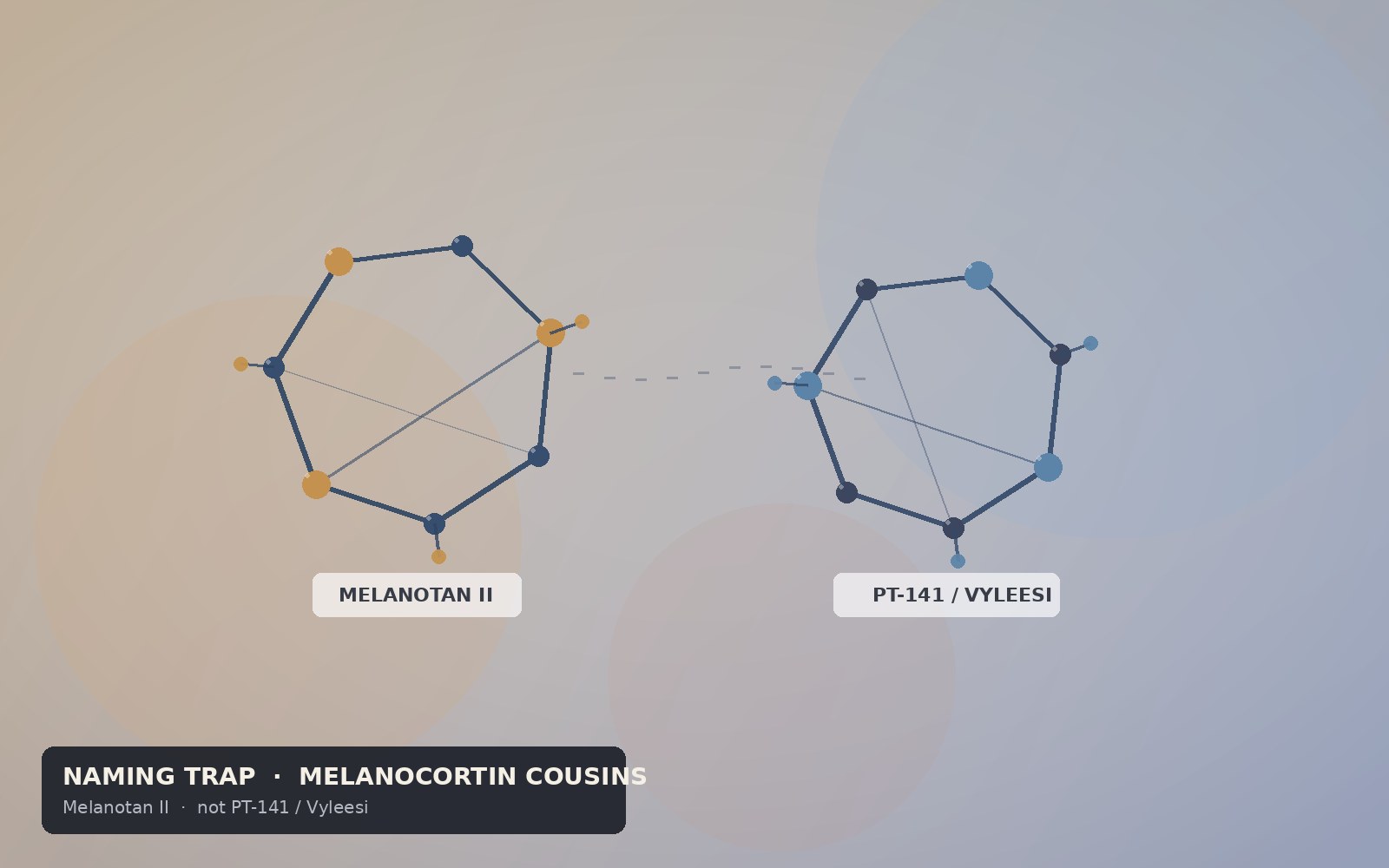
TikTok treats “the tanning peptide” and “PT-141” like nicknames for the same vial. They sit on the same melanocortin family tree. Only one of them has an FDA-approved drug story — and it isn’t a sunless-tan product.
Inspired Labs Editorial/Sep 25, 2026/6 sources
Melanotan II Is Not PT-141
Picture two nearly identical keys on a ring.
One was forged so people could tan without a beach week. The other was refined into a labeled drug for a specific sexual-desire diagnosis. Online, both get called “the peptide,” “MT,” or “PT” like that distinction is optional.
It isn’t.
Literature, not lore.
So here’s the clean split: Melanotan II is a research melanocortin story with early human pilots. PT-141 is the catalog nickname people use for bremelanotide — and Vyleesi is the FDA-approved autoinjector product in that second story.
Wait, are they related or not?
Yes. Related. Not identical.
Both are short peptides that lean on melanocortin receptors — the same signaling family your body uses for pigment and, separately, pieces of sexual arousal wiring. Think cousins who share a last name and a family reunion, then go home to different houses.
Melanotan II (often shortened to MT-II) is a cyclic heptapeptide built as a tougher cousin of α-MSH, the hormone that tells pigment cells to darken. University of Arizona–lineage chemists designed it as a “superpotent” tanning tool.
PT-141 started in that same melanocortin toolkit. Victor Hadley’s 2006 review puts Melanotan I and Melanotan II in the early clinical lane. It then names PT-141 (Palatin) as the analog that moved into sexual-function trials instead of a sunless-tan product.
Same neighborhood. Different destination.
So what did Melanotan II’s early human work actually show?
A 1996 pilot phase I study by Dorr and colleagues gave Melanotan II to three healthy men in a tiny, carefully watched dose-escalation setup. That’s early human research in the most literal sense: three people, not a stadium.
They reported more facial and upper-body pigment after a handful of low doses. They also reported nausea, sleepiness at higher amounts, and unexpected erections that showed up without anyone planning a romance novel scene.
A few years later, researchers tried Melanotan II in twenty men with erectile dysfunction. In a small placebo-controlled crossover study, it could trigger erections and bump desire scores. Nausea was a frequent tax.
Useful for understanding the receptor family? Sure. A sunless-tan approval package? No. A substitute for Vyleesi? Also no.
Related melanocortin peptides can share a family tree and still fail the “same product” test.
Then what is PT-141 / Vyleesi?
PT-141 is the research-shelf nickname people paste onto bremelanotide.
Bremelanotide is the melanocortin agonist that finished the long regulatory walk. In 2019, the FDA approved Vyleesi — an as-needed subcutaneous autoinjector of bremelanotide — for acquired, generalized hypoactive sexual desire disorder in premenopausal women. That’s approved-drug context for a labeled product, not a research vial cosplay.
The big human evidence sits in RECONNECT: two matching phase 3 trials that randomized about 1,267 premenopausal women and analyzed roughly 1,247 for safety. Desire and distress scores moved versus placebo over 24 weeks of as-needed use. That’s human clinical trial territory — and it still doesn’t mint Melanotan II into that label.
If you want the full PT-141 / Vyleesi brief we already published, start there. This piece is the cousin warning label.
Why does the internet mash the names?
Because the family resemblance is real, and the marketing language is lazy.
Forensic labs have already met both compounds on the black market of “performance and image enhancing” products. A 2021 drug-testing paper characterized Melanotan II and bremelanotide in seized samples sold next to steroids and stimulants. Same shopping bag energy. Different molecules when you put them under high-resolution mass spectrometry.
Forum posts do the rest: “tanning peptide,” “PT,” “MT-II,” “the Arizona peptide,” “Vyleesi research.” Once the nicknames blur, so does the product story.
Here’s the plain version. Melanotan II’s early pilots watched pigment and side effects in tiny groups. Bremelanotide / Vyleesi has a labeled indication, an autoinjector presentation, and phase 3 trials sized like real drug development. A research vial labeled PT-141 is still a chemical conversation, not that autoinjector.
The one thing to remember
Melanotan II and PT-141 / bremelanotide are melanocortin cousins. Only bremelanotide became Vyleesi — an FDA-approved product for a specific desire diagnosis in premenopausal women. Melanotan II is not that drug, not a sunless-tan approval, and not a nickname you can safely paste onto a PT-141 vial.
Sources
- 01Evaluation of melanotan-II, a superpotent cyclic melanotropic peptide in a pilot phase-I clinical study — Dorr RT, et al. (1996). Life Sciences.
PMID 8637402. Early human pilot (n=3): pigment changes after low-dose MT-II; nausea, fatigue, spontaneous erections noted.
- 02Melanocortin receptor agonists, penile erection, and sexual motivation: human studies with Melanotan II — Wessells H, et al. (2000). International Journal of Impotence Research.
PMID 11035391. Small placebo-controlled crossover in 20 men with ED; erections and desire signals; nausea common.
- 03Melanocortin peptide therapeutics: historical milestones, clinical studies and commercialization — Hadley ME, Dorr RT. (2006). Peptides.
PMID 16412534. Maps Melanotan I/II clinical history and names PT-141 as the sexual-function analog moving toward commercialization.
- 04Bremelanotide for the Treatment of Hypoactive Sexual Desire Disorder: Two Randomized Phase 3 Trials — Kingsberg SA, et al. (2019). Obstetrics & Gynecology.
PMID 31599840. RECONNECT phase 3 pair; ~1,267 randomized; desire/distress coprimary endpoints vs placebo.
- 05FDA approves new treatment for hypoactive sexual desire disorder in premenopausal women — U.S. Food and Drug Administration (2019). U.S. Food and Drug Administration.
Press announcement for Vyleesi (bremelanotide). Regulatory / approved-drug context for the labeled autoinjector — not Melanotan II.
- 06LC-HRMS characterization of the skin pigmentation and sexual enhancers melanotan II and bremelanotide sold on the black market… — Mestria S, et al. (2021). Drug Testing and Analysis.
PMID 33245851. Forensic ID of both compounds in seized PIED samples — naming mash-up meets analytical chemistry.
Educational material for laboratory research context only. Nothing here is medical advice, a protocol for human use, or a claim that Inspired Labs products diagnose, treat, cure, or prevent disease.
Previous
SLU-PP-332 Is Not a Research Peptide
Next
Orforglipron is not a research GLP vial: An oral small-molecule pill (Foundayo), not a peptide, and not ILGLP-*
Continue

Your Muscle Noticed Menopause. Science Still Points at Iron.
After menopause, honestly
Your Muscle Noticed Menopause. Science Still Points at Iron.
Read brief → 3 min

Your Tendons Are Still Running on Your Teenage Collagen
Recovery, honestly
Your Tendons Are Still Running on Your Teenage Collagen
Read brief → 3 min

The Holiday Pound Is Small. It Just Never Leaves.
Weight, honestly
The Holiday Pound Is Small. It Just Never Leaves.
Read brief → 3 min