Regulatory/Regulation
Orforglipron is not a research GLP vial: An oral small-molecule pill (Foundayo), not a peptide, and not ILGLP-*
Orforglipron (LY3502970) is a once-daily oral non-peptide GLP-1 receptor agonist. Foundayo is Lilly’s labeled tablet for weight management — not a lyophilized peptide research vial, and not ILGLP-1, ILGLP-2, or ILGLP-3.
Inspired Labs Editorial/Sep 24, 2026/7 sources
Orforglipron is not a research GLP vial: An oral small-molecule pill (Foundayo), not a peptide, and not ILGLP-*
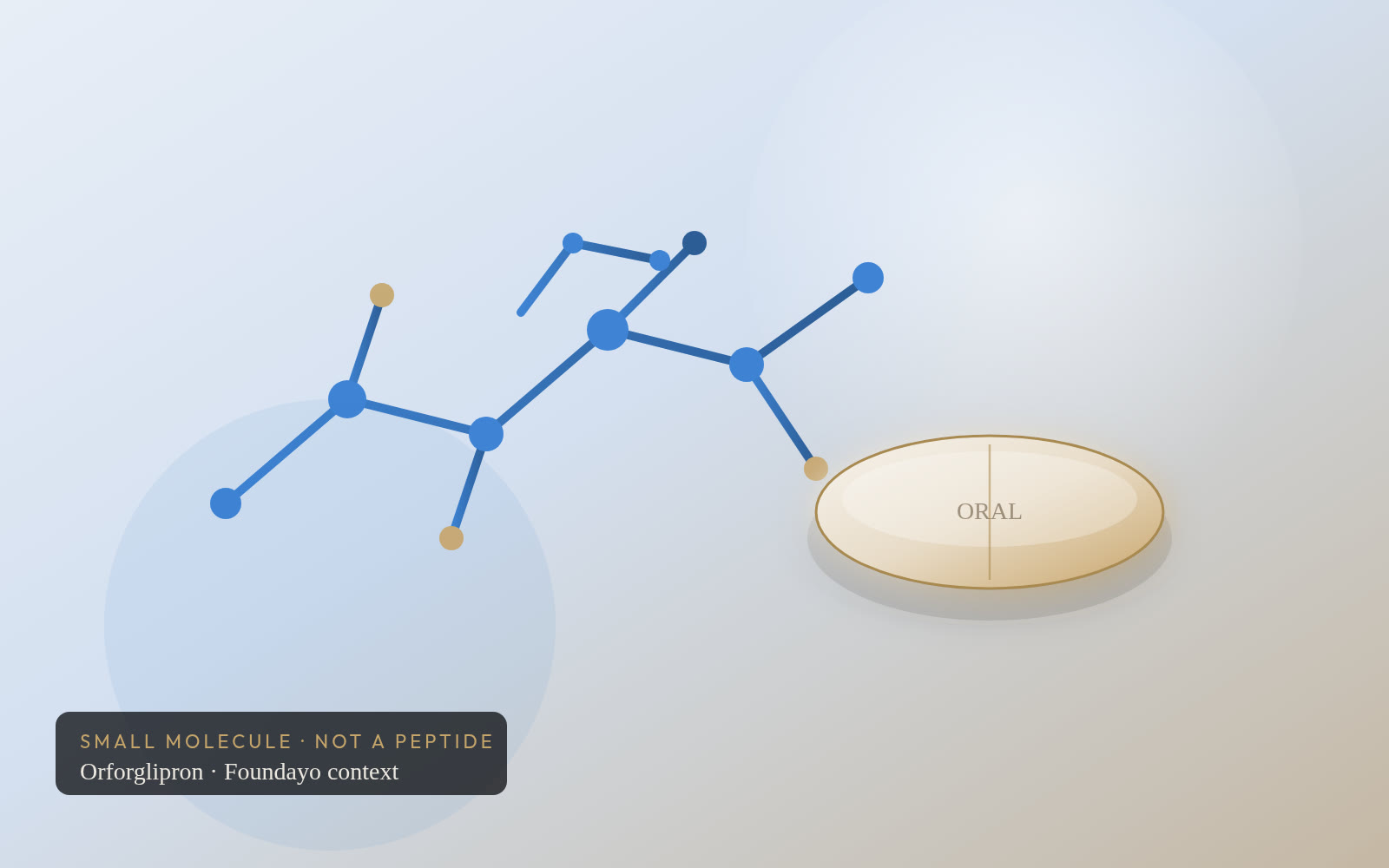
When search language hears “oral GLP,” it reaches for a familiar peptide vial. Orforglipron is not that shortcut. It is Eli Lilly’s once-daily small-molecule (non-peptide) GLP-1 receptor agonist — development code LY3502970, branded Foundayo for chronic weight management — a tablet chemistry story, not a lyophilized research peptide.
Literature, not lore.
A peptide is a short chain of amino acids. Orforglipron is not one. Kawai and colleagues mapped how this orally active nonpeptide agonist docks the GLP-1 receptor without being a peptide at all. Inspired Labs’ customer shorthand maps Semaglutide → ILGLP-1, Tirzepatide → ILGLP-2, and Retatrutide → ILGLP-3 for catalog conversation. Those labels are research-shelf names in a naming conversation. They are not Foundayo, not orforglipron, not sequence claims, and not trial equivalence.
A small molecule is not a peptide vial
GLP-1 receptor agonists come in more than one chemical family. Semaglutide and tirzepatide are peptide medicines in their approved injectable (and, for oral semaglutide, peptide-tablet) product contexts. Orforglipron sits on a different shelf: a synthetic small molecule designed to turn on the same receptor class without being built from amino-acid chains.
Grade: early lab / animal research for the structural pharmacology paper (Kawai et al., PNAS, 2020): cryo-EM and receptor chemistry establishing LY3502970 as an orally active nonpeptide agonist. That lab file is not a human dosing protocol, and it is not a research-vial identity.
A GLP-1 receptor agonist that is not a peptide is still not a lyophilized research peptide — and not an ILGLP nickname.
If you want the trunk of the incretin conversation first, start with the Journal brief on how GLP-1 changed the conversation. That brief is adjacent reading. It is not a product swap for orforglipron.
What orforglipron / Foundayo actually is
Orforglipron (or-for-GLIP-ron; LY3502970) is a once-daily oral small-molecule GLP-1 receptor agonist discovered by Chugai Pharmaceutical and licensed by Lilly in 2018. Company materials emphasize it can be taken any time of day without food or water timing restrictions — a formulation contrast with oral peptide semaglutide’s co-formulated absorption rules, not a claim about any research lot.
Foundayo is Lilly’s U.S. brand name for orforglipron tablets. Lilly’s EASD 2026 communications and the product safety summary describe Foundayo as FDA-approved for adults with obesity, or some adults with overweight plus weight-related medical problems, for chronic weight management alongside diet and activity. Type 2 diabetes remains an active Phase 3 / regulatory path — studied extensively, not the same as “already the diabetes label” in every market sentence. Grade: approved drug (different product context) for the weight-management tablet; regulatory context for the still-separate diabetes development story.
None of that turns Foundayo into a research peptide vial. None of it creates an Inspired Labs catalog SKU. And none of it renames ILGLP-1, ILGLP-2, or ILGLP-3.
Readers will still mash the names: “oral GLP,” “Foundayo,” “orfor,” “sema pill,” “research vial,” “ILGLP.” The honest split is modality and product identity. A labeled oral small-molecule tablet is not a lyophilized peptide research object. Inspired Labs ILGLP-* labels are research catalog conversation shorthand for Sema / Tirz / Reta adjacency. This Journal does not claim sequence, composition, or trial equivalence between those lots and any Lilly drug-development object.
ACHIEVE-3: head-to-head with oral semaglutide
ACHIEVE-3 (NCT06045221) is a Phase 3, 52-week, open-label trial comparing once-daily orforglipron (12 mg or 36 mg) with oral semaglutide (7 mg or 14 mg) in adults with type 2 diabetes inadequately controlled on metformin. About 1,698 participants were randomized across those four arms. Results were published in The Lancet (online February 26, 2026) and ClinicalTrials.gov posted study results around September 15, 2026 — the same mid-September window as Lilly’s EASD package.
Estimands answer different questions. Keep them apart.
Under the efficacy estimand (effect if people stayed on randomized treatment), Lilly’s February 26, 2026 release reported mean A1C change from a baseline of about 8.3% at week 52 as roughly −1.9% with orforglipron 12 mg, −2.2% with orforglipron 36 mg, −1.1% with oral semaglutide 7 mg, and −1.4% with oral semaglutide 14 mg. Weight change under that framing was about −6.7% and −9.2% for the two orforglipron doses versus about −3.7% and −5.3% for the two oral-semaglutide doses.
Under the treatment-regimen estimand (average effect regardless of adherence or rescue), the Lancet abstract reported mean changes of about −1.71%, −1.91%, −1.23%, and −1.47% for those same four arms. Both sets can be true. They are not interchangeable. Prespecified non-inferiority was met; hierarchical superiority tests favored both orforglipron doses against both oral-semaglutide doses in the published analysis. Grade: human clinical trial.
A Phase 3 diabetes head-to-head still does not mint a research-vial nickname. Oral semaglutide in that trial is a peptide tablet comparator. Orforglipron is the non-peptide small-molecule arm. Neither arm is ILGLP-1.
ACHIEVE, ATTAIN, and the mid-Sep EASD frame
Lilly’s type 2 diabetes Phase 3 program for orforglipron is branded ACHIEVE; the obesity / overweight registration program is branded ATTAIN. Those names travel in headlines next to Foundayo. They are not catalog SKUs.
On September 15, 2026, Lilly announced an EASD 2026 symposium package (Milan, September 28–October 2) that includes Foundayo ACHIEVE-program data. For ACHIEVE-4 — adults with type 2 diabetes and obesity or overweight at increased cardiovascular risk, versus insulin glargine — Lilly reported cardiovascular non-inferiority with hazard ratios of about 0.84 for MACE-4 (95% CI 0.59–1.20) and about 0.77 for MACE-3 (95% CI 0.52–1.13). Company language framed a safety profile plus “potential to provide cardiovascular benefits,” not a free-standing superiority claim from that teaser alone. Grade: human clinical trial for the reported endpoints; full symposium detail was still ahead of the meeting dates when this brief was written.
That mid-September traffic is why the naming trap matters this week. “Oral GLP headlines” and “Foundayo” will get pasted onto research-peptide search boxes. The chemistry does not follow.
Approved tablet ≠ research peptide ≠ ILGLP-*
Foundayo’s U.S. weight-management approval (April 2026, per FDA and Lilly communications) is a real regulatory fact. Grade: approved drug (different product context). It is also a different product context from injectable peptide GLP-1 / dual agonists, from oral peptide semaglutide, from any lyophilized research peptide vial, and from Inspired Labs ILGLP conversation labels.
Approval for chronic weight management does not mean “any oral GLP search equals a research lot.” It does not mean Inspired Labs sells orforglipron. It does not collapse small-molecule tablet chemistry into peptide-vial identity. And a type 2 diabetes Phase 3 program still sitting in study and submission language is not a license to invent catalog equivalence.
Sources
- 01Structural basis for GLP-1 receptor activation by LY3502970, an orally active nonpeptide agonist — Kawai T, et al. (2020). Proceedings of the National Academy of Sciences.
PMID 33177239. Cryo-EM / receptor pharmacology establishing LY3502970 (orforglipron) as an orally active nonpeptide GLP-1 receptor agonist.
- 02Efficacy and safety of once-daily oral orforglipron compared with oral semaglutide in adults with type 2 diabetes (ACHIEVE-3) — Rosenstock J, et al. (2026). The Lancet.
PMID 41765029. Peer-reviewed Phase 3 head-to-head (NCT06045221); treatment-regimen estimand A1C changes ~−1.71% / −1.91% (orforglipron 12 / 36 mg) vs ~−1.23% / −1.47% (oral semaglutide 7 / 14 mg) from baseline ~8.3% at week 52.
- 03Lilly's oral GLP-1, orforglipron, delivered superior blood sugar control and weight loss compared to oral semaglutide — Eli Lilly and Company (2026). Company news release.
26 Feb 2026. Efficacy-estimand table: A1C ~−1.9% / −2.2% (orforglipron 12 / 36 mg) vs ~−1.1% / −1.4% (oral semaglutide 7 / 14 mg); weight ~−6.7% / −9.2% vs ~−3.7% / −5.3%.
- 04ClinicalTrials.gov — ACHIEVE-3 (NCT06045221) (2026). ClinicalTrials.gov.
Phase 3 orforglipron vs oral semaglutide in type 2 diabetes on metformin; results first posted ~September 15, 2026. Registry context — not a research-vial identity.
- 05FDA approves Lilly's Foundayo (orforglipron), the only GLP-1 pill — Eli Lilly and Company (2026). Investor news release.
1 Apr 2026. U.S. approval of Foundayo (orforglipron) tablets for chronic weight management in adults with obesity or overweight with weight-related conditions (NDA 220934 context).
- 06Lilly to present new data on Foundayo, retatrutide, and eloraTZP at EASD 2026 — Eli Lilly and Company (2026). PR Newswire.
15 Sep 2026. EASD package framing; ACHIEVE-4 MACE-4 HR ~0.84 (95% CI 0.59–1.20) and MACE-3 HR ~0.77 (95% CI 0.52–1.13) vs insulin glargine; Foundayo described as FDA-approved for weight management while orforglipron continues study in type 2 diabetes.
- 07Effect of Food Consumption on the Pharmacokinetics of Once-Daily Orally Administered Orforglipron (LY3502970), a Non-peptide GLP-1 Receptor Agonist — Ma X, et al. (2024). Diabetes Therapy.
PMID 38402332. Clinical pharmacology context for oral non-peptide administration without food/water restrictions — not a research-vial claim.
Educational material for laboratory research context only. Nothing here is medical advice, a protocol for human use, or a claim that Inspired Labs products diagnose, treat, cure, or prevent disease.
Previous
Melanotan II Is Not PT-141
Next
Thymosin α1: A different thymic peptide — and a large sepsis trial that did not move mortality
Continue

Your Muscle Noticed Menopause. Science Still Points at Iron.
After menopause, honestly
Your Muscle Noticed Menopause. Science Still Points at Iron.
Read brief → 3 min

Your Tendons Are Still Running on Your Teenage Collagen
Recovery, honestly
Your Tendons Are Still Running on Your Teenage Collagen
Read brief → 3 min

The Holiday Pound Is Small. It Just Never Leaves.
Weight, honestly
The Holiday Pound Is Small. It Just Never Leaves.
Read brief → 3 min