
Two knobs/Compounds
Survodutide Is Not a Research GLP Vial
Survodutide turns GLP-1 and glucagon on one weekly shot. Fresh Phase 3 numbers in people with obesity and type 2 diabetes are not a research-vial remix — and not yesterday’s four-knob peptide that skipped glucagon.
Inspired Labs Editorial/Oct 4, 2026/8 sources
Survodutide Is Not a Research GLP Vial
Someone screenshots a Phase 3 headline that says “glucagon,” then DMs a friend asking which research vial that is.
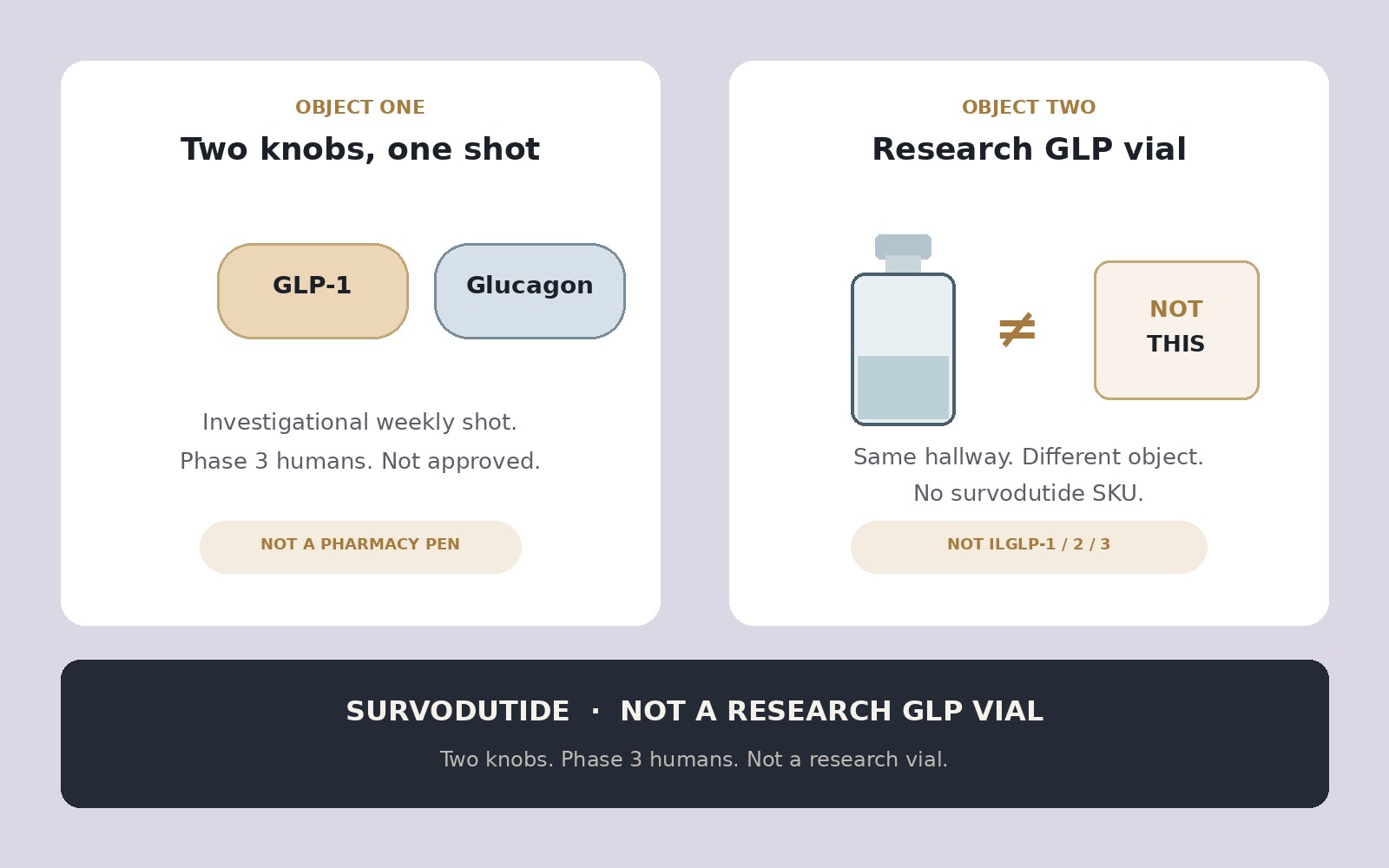
Here is the kindly fix. Survodutide is Boehringer and Zealand’s investigational once-weekly shot that turns two knobs at once: GLP-1 and glucagon. It is not a lyophilized “glucagon peptide” mash-up on a research shelf. And it is not yesterday’s four-knob story.
Picture a remote. Four Knobs, and None of Them Is Glucagon was about a peptide that skips the glucagon dial. Survodutide’s remote turns GLP-1 plus glucagon. One drug. Two knobs. Real human Phase 3 numbers just landed.
Our house rule is Literature, not lore. The wider ladder is already up in Is the Future of Weight Loss Already Here? If you want the gut-hormone trunk first, start with how GLP-1 changed the conversation.
So what is survodutide, exactly?
Survodutide — also coded BI 456906 — is a dual agonist. Dual means one molecule aimed at two hormone receptors. GLP-1 is the familiar “full and slower stomach” signal. Glucagon is the liver-leaning knob people often mix up with blood-sugar panic.
The companies say the glucagon side is there to help shift metabolism, including liver fat, while GLP-1 still handles appetite. That is mechanism talk from the developers. It is not a promise about your next lab result.
Zealand invented the chain. Boehringer is developing it. As of today it is investigational. Not approved. Not a pen you can pick up at the pharmacy.
What did the new Phase 3 actually show?
SYNCHRONIZE-2 enrolled about seven hundred fifty adults living with overweight or obesity and type 2 diabetes. People got a weekly shot for seventy-six weeks — roughly a year and a half — at one of two planned maintenance levels, or a look-alike placebo. Everyone also got diet and activity counseling.
If you count everyone who started — the more conservative “what happened in the real trial” framing — average weight loss landed near about 8% on the lower plan and about 10% on the higher plan, versus about 4% on placebo. About six in ten people on the shot lost at least 5% of their starting weight, versus about one in three on placebo.
Headline numbers in company press are bigger. Those “up to about 13%” lines use a different math frame that leans on people who stayed on treatment as planned. Both frames are real. The quieter one belongs in the body. The louder one lives in the sources.
Blood-sugar markers moved too. Press coverage of the sticking-with-it frame reported HbA1c dropping by up to about 1.2 points from a starting average near 7.4%. That is a lab number from a trial, not a treatment plan for you.
Two knobs on one chain is not the same object as a research GLP vial.
How rough was the stomach story?
Pretty rough for some people, in the way GLP-class shots often are. Nausea, vomiting, diarrhea, and constipation showed up more often on survodutide than on placebo. Most of those events were mild to moderate.
About 18% of people on the drug stopped because of gut side effects, versus about 1% on placebo. Stops clustered during the climb-up weeks, when the protocol left less room to slow the ramp. Later studies are supposed to allow gentler, more personal titration. That is a design note, not a guarantee.
Serious events were not more common on the drug than on placebo in the summary coverage. Still investigational. Still not a shopping list.
Is this the same as retatrutide — or as “four knobs”?
No. Retatrutide’s public story is three knobs: GLP-1, GIP, and glucagon. Survodutide’s public story is two: GLP-1 and glucagon. Different companies. Different molecules. Different trial files.
And PTT-A — the TikTok four-knob peptide — skips glucagon on purpose and leans on amylin plus calcitonin instead. That one is still in rats. Survodutide is already in large human Phase 3. Do not let “glucagon” in a caption glue those objects together.
A named capsule such as NA-931 is yet another file. Same conversation. Different object. See Is the Next Weight-Loss Capsule Already Named?
Did fat vs muscle get measured?
Carefully, and not in this diabetes trial’s main story. On the same meeting day, a small MRI substudy from SYNCHRONIZE-1 — people with obesity without diabetes, seventy-five scanned — suggested more of the loss came from visceral and liver fat, with muscle making up no more than about a tenth of the tissue lost.
That is early body-composition work from a substudy. It is not a full muscle-preservation claim for everyone on survodutide. And it is not a reason to order a “glucagon vial” labeled like a cartoon remote.
So is there a research vial for this?
Not from Inspired Labs. We do not catalog survodutide. We do not invent a SKU for it.
Around the research shelf you will hear ILGLP-1, ILGLP-2, and ILGLP-3. Those are conversation labels for Sema / Tirz / Reta adjacency — same hallway of reading, different objects. They are not brand twins, not sequence claims, and not “this vial is the SYNCHRONIZE trial.”
For how we grade that gap, see how this journal grades evidence. For the fence around the language, see what Research Use Only means. Research Use Only means laboratory research. It is not a Phase 3 headline you can reconstitute.
The one thing to remember
Survodutide is a two-knob weekly shot with fresh Phase 3 numbers in people who also have type 2 diabetes. If you remember one thing: the glucagon knob just got human data — and that data is not a research GLP vial.
Sources
- 01Boehringer Ingelheim press release — SYNCHRONIZE-2 topline (Oct 1, 2026) (2026). GlobeNewswire.
Survodutide (BI 456906) = investigational once-weekly glucagon/GLP-1 dual agonist; licensed from Zealand Pharma; not approved. SYNCHRONIZE-2: 755 adults with obesity/overweight and T2D; 3.6 mg or 6.0 mg weekly vs placebo; 76 weeks; co-primary % body-weight change and ≥5% loss. Efficacy-estimand framing in press: up to 13.1% mean weight loss vs 3.1% placebo; up to 79.3% vs 32.7% achieving ≥5%; HbA1c reduction up to 1.21% from baseline 7.4% vs 0.03% placebo; waist −11.1 cm vs −3.5 cm; up to 29.5% vs 4.0% reverted to HbA1c <5.7%. GI events most common; discontinuation due to GI 18% vs 1.2% placebo, mostly during escalation. Presented EASD 2026; simultaneous NEJM. Sponsor-funded.
- 02Wharton et al. — SYNCHRONIZE-2 NEJM (Oct 1, 2026) — Wharton et al. (2026). N Engl J Med.
Title per press: “Survodutide Once Weekly in Adults with Obesity and Type 2 Diabetes.” Full text may be paywalled; numbers cross-checked via press + Healio + AJMC. Trial registry: NCT06066528 (enrollment listed 755; completed).
- 03Healio — treatment-regimen framing of SYNCHRONIZE-2 (Oct 1, 2026) — Michael Monostra (2026). Healio.
Michael Monostra. Treatment-regimen: −8.2% (3.6 mg) and −9.8% (6 mg) vs −3.9% placebo at 76 weeks. Efficacy: −10.4% / −13.1% vs −3.1%. ≥5% responders: 57.6% / 64.5% vs 35.1% (Healio does not split that responder line by estimand in the summary; treat as reported). Healio HbA1c change −0.9 / −0.8 vs −0.2 percentage points (differs from press efficacy “up to 1.21%” — both noted; body used press only for the sticking-with-it A1c line). GI AEs 72.8% / 77.7% vs 38.6%; GI discontinuation 18% / 17.9% vs 1.2%. Healio n=752 vs press/CT.gov 755 — minor reporting difference; body used “about seven hundred fifty.” Funded by Boehringer; Wharton disclosures listed on Healio.
- 04AJMC — SYNCHRONIZE-2 + body-composition substudy context (Oct 1, 2026) — Giuliana Grossi (2026). AJMC.
Giuliana Grossi. Confirms efficacy headlines, glycemic secondaries, 18% vs 1.2% GI discontinuation, n=755. Notes SYNCHRONIZE-1 efficacy framing up to 15.3% / 16.6% vs 3.2% placebo (no-diabetes cohort). Body-composition substudy of SYNCHRONIZE-1 (Pietiläinen, EASD oral, n=75 without T2D): preferential visceral/liver fat reduction; muscle ≤10% of tissue lost — early/substudy language only. Mentions upcoming SYNCHRONIZE-CVOT and LIVERAGE MASH program; FDA Breakthrough Therapy for MASH (2024) is regulatory context, not approval for weight loss.
- 05SYNCHRONIZE-1 — no-diabetes Phase 3 (NEJM) (2026). N Engl J Med.
NCT06066515. Treatment-regimen mean weight change at week 76 ~−12.2% (3.6 mg) / −13.0% (6.0 mg) vs −5.4% placebo (per secondary summaries of the NEJM primary analysis). Efficacy framing previously reported up to ~16.6%. Context only for “without diabetes” vs SYNCHRONIZE-2 “with diabetes.” Published online June 7, 2026 at NEJM.org per page metadata.
- 06ClinicalTrials.gov — SYNCHRONIZE-2 registry (2026). ClinicalTrials.gov.
Phase 3; Boehringer Ingelheim; actual enrollment 755; once-weekly subcutaneous survodutide 3.6 mg or 6.0 mg vs placebo; primary outcomes percent body-weight change and ≥5% achievement to week 76. Status completed as of the Oct 2026 check.
- 07Zealand Pharma companion announcement (Oct 1, 2026) (2026). GlobeNewswire.
Company announcement No. 52 / 2026. Confirms license relationship and cites Wharton et al. DOI 10.1056/NEJMoa2607219. Same efficacy topline as BI press.
- 08How to read the gap (2026). Inspired Labs Journal.
Live Journal: how this journal grades evidence and what Research Use Only means (https://b4pep.com/blog/ruo-is-a-fence). Grading and RUO context — not a survodutide dataset. Soft catalog adjacency: ILGLP-1 / ILGLP-2 / ILGLP-3 families only; no survodutide SKU.
Educational material for laboratory research context only. Nothing here is medical advice, a protocol for human use, or a claim that Inspired Labs products diagnose, treat, cure, or prevent disease.
Continue
Your Muscle Noticed Menopause. Science Still Points at Iron.
After menopause, honestly
Your Muscle Noticed Menopause. Science Still Points at Iron.
Read brief → 3 min

Your Tendons Are Still Running on Your Teenage Collagen
Recovery, honestly
Your Tendons Are Still Running on Your Teenage Collagen
Read brief → 3 min

The Holiday Pound Is Small. It Just Never Leaves.
Weight, honestly
The Holiday Pound Is Small. It Just Never Leaves.
Read brief → 3 min