Recovery, after dark/Compounds
Your Best Growth Hormone Spike Happens in Bed
Your body's biggest growth hormone pulse shows up in deep sleep. The surprise: in trials, more growth hormone made muscles bigger on the scale, not stronger in the gym.
Inspired Labs Editorial/Oct 28, 2026/13 sources
Your Best Growth Hormone Spike Happens in Bed
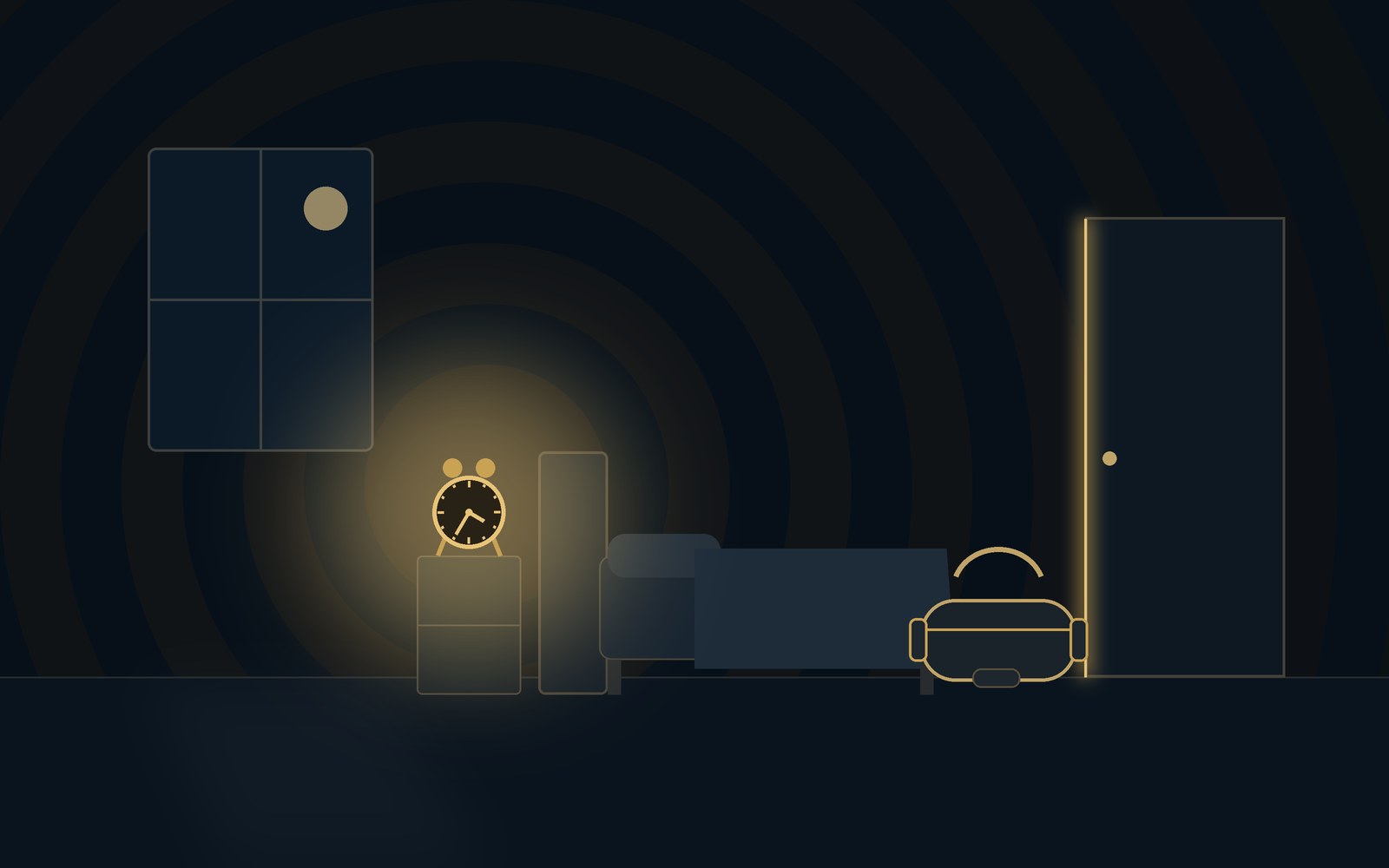
You crushed leg day, skipped dinner, scrolled till 1 a.m., and woke up at six feeling like wet cardboard. Then your feed served you a peptide that "boosts growth hormone while you sleep."
Funny timing. Your body already runs that shift. You just cut it short.
When does your body actually make growth hormone?
Mostly at night. A University of Chicago team pooled sleep-lab data on 149 healthy men and found growth hormone release tracked closely with deep, slow-wave sleep.
Think of growth hormone as the factory whistle. It blows loudest in deep sleep and tells the crew it's time to repair. But the whistle isn't the crew. Training and food are the crew.
One more catch: deep sleep shrank a lot from the late teens to midlife, and growth hormone fell right along with it. That study was men only, so we can't stretch it to everyone.
Does skipping sleep really cost you muscle?
It costs you building time. In one small study, one night with no sleep cut muscle protein building the next day by about a fifth.
Another study gave young men five nights of four hours in bed. Their muscle building slowed too. The twist: the group that also did hard interval sessions held steady. Your training still talks, even when you're tired.
What actually helps overnight?
The boring stuff, which is also the stuff with receipts.
Protect the long sleep. Deep sleep clusters early in the night, so a late bedtime eats into the best part of the whistle.
Eat some protein before bed. In a 12-week Dutch trial of 44 young lifters, a bedtime protein drink beat a dummy drink for both strength and thigh muscle size.
Keep the training progressive. A McMaster study had men train one arm with a big post-workout hormone rush and the other without. Both arms grew about the same. The rush didn't matter. The lifting did.
If you remember the whistle: a louder whistle didn't make the crew work harder.
Growth hormone is the factory whistle. Training and protein are the crew.
So what about the growth hormone peptides?
Here's where the internet gets ahead of itself. The pitch goes: more growth hormone equals more muscle. The trials say otherwise.
A Stanford-led review pulled together the randomized trials that gave actual growth hormone to fit, healthy young adults. Lean mass went up by roughly four or five pounds. Strength and exercise capacity didn't improve. The growth hormone groups also had more swelling and fatigue.
That's the real hormone. The peptides are one step further back.
CJC-1295 was built to make the body release more of its own growth hormone. In a 2006 trial in healthy adults, it raised growth hormone and a related marker, IGF-1, for days. That study measured blood levels. It didn't measure muscle or strength.
Ipamorelin nudges the same system through a different door. Its biggest human trial wasn't about the gym at all. It tested gut recovery after bowel surgery, and it didn't beat placebo.
So the honest grade: real human data on hormone levels, none showing these peptides build muscle or strength.
Isn't the government about to make these legal?
You may have seen the headlines. On Oct 28, HHS filed an enforcement-discretion policy covering six peptides, letting licensed pharmacies compound them by prescription while FDA writes the rules. CJC-1295 and ipamorelin are not among them, and HHS itself says compounded drugs aren't FDA-approved.
Meanwhile, the FDA's own safety list still flags both. For CJC-1295 it cites serious reactions, including a racing heart and flushing. For ipamorelin it cites serious events, including a death, in a hospital IV study. Literature, not lore: a policy that leaves them out isn't a green light.
Inspired Labs carries research compounds for lab study only. A research vial isn't a shortcut to the night shift your body already runs.
If you remember one thing…
Growth hormone is the whistle, not the work. Sleep long, eat some protein, lift with intent, and let the crew do its job.
Research Use Only: everything Inspired Labs carries is lab material, not for your body. Nothing here is medical advice.
Sources
- 01Age-related changes in slow wave sleep and REM sleep and relationship with growth hormone and cortisol levels in healthy men — Van Cauter E, Leproult R, Plat L (2000). JAMA.
Human observational study pooling sleep-lab data on 149 healthy men aged 16 to 83. Slow-wave sleep fell sharply between the late teens and midlife, paralleled by a major decline in growth hormone; growth hormone secretion tracked slow-wave sleep independent of age. Men only.
- 02The effect of acute sleep deprivation on skeletal muscle protein synthesis and the hormonal environment — Lamon S, Morabito A, Arentson-Lantz E, et al. (2021). Physiol Rep.
Randomized crossover study in 13 healthy young adults (7 men, 6 women). One night of total sleep deprivation cut post-meal muscle protein synthesis by 18%, raised cortisol and lowered testosterone.
- 03The effect of sleep restriction, with or without high-intensity interval exercise, on myofibrillar protein synthesis in healthy young men — Saner NJ, Lee MJ, Pitchford NW, et al. (2020). J Physiol.
Randomized study of 24 young men in three groups over five nights of four versus eight hours in bed. Muscle protein synthesis was lower with sleep restriction and was maintained when high-intensity interval exercise was added.
- 04Protein ingestion before sleep increases muscle mass and strength gains during prolonged resistance-type exercise training in healthy young men — Snijders T, Res PT, Smeets JS, et al. (2015). J Nutr.
Randomized trial of 44 young men over 12 weeks of progressive resistance training: nightly pre-sleep protein versus a noncaloric placebo produced greater strength and thigh muscle size gains. One co-author was from DSM Biotechnology Center.
- 05Elevations in ostensibly anabolic hormones with resistance exercise enhance neither training-induced muscle hypertrophy nor strength of the elbow flexors — West DWD, Burd NA, Tang JE, et al. (2010). J Appl Physiol.
Within-subject training study of 12 young men over 15 weeks: the arm trained with a large post-exercise hormone rise grew about the same as the arm trained without it (12% vs 10%), and strength gains did not differ.
- 06Systematic review: the effects of growth hormone on athletic performance — Liu H, Bravata DM, Olkin I, et al. (2008). Ann Intern Med.
Systematic review of randomized trials in 303 healthy, fit participants given growth hormone: lean body mass rose about 2.1 kg, strength and exercise capacity did not seem to improve, and soft-tissue swelling and fatigue were more common. The authors conclude claims that growth hormone enhances physical performance are not supported.
- 07Prolonged stimulation of growth hormone (GH) and insulin-like growth factor I secretion by CJC-1295, a long-acting analog of GH-releasing hormone, in healthy adults — Teichman SL, Neale A, Lawrence B, et al. (2006). J Clin Endocrinol Metab.
Two randomized, placebo-controlled trials in healthy adults aged 21 to 61 showing sustained rises in growth hormone and IGF-I for days. Outcomes were drug levels, hormone levels and safety, not muscle or strength.
- 08Prospective, randomized, controlled, proof-of-concept study of the ghrelin mimetic ipamorelin for the management of postoperative ileus in bowel resection patients — Beck DE, Sweeney WB, McCarter MD; Ipamorelin 201 Study Group (2014). Int J Colorectal Dis.
Phase 2 randomized trial in 114 patients after bowel resection: no significant difference versus placebo on key or secondary efficacy outcomes.
- 09Certain Bulk Drug Substances for Use in Compounding that May Present Significant Safety Risks — U.S. Food and Drug Administration (2026). FDA (content current as of Apr 22, 2026; accessed Oct 28, 2026).
Regulatory listing. For CJC-1295, FDA cites serious adverse events including increased heart rate and a systemic vasodilatory reaction, with limited clinical data. For ipamorelin acetate, FDA cites serious adverse events including death when it was given intravenously to improve gastric motility.
- 10Peptide drugs plan advanced by Trump administration, RFK Jr. — CNBC (2026). CNBC (Oct 15, 2026).
News report: HHS submitted a peptides interim access policy to the White House budget office for review. The filing gives no specifics.
- 11Enforcement Discretion Policy Regarding 503A Compounding Using Certain Peptide Bulk Drug Substances — U.S. Department of Health and Human Services (2026). Federal Register public inspection, FR Doc. 2026-22192 (filed Oct 28, 2026; publication Oct 30, 2026).
Regulatory notice: HHS does not intend to take enforcement action against state-licensed pharmacies, federal facilities, or licensed physicians compounding the peptides listed in the policy's appendix while FDA develops the 503A list through rulemaking. Compounded drugs are not FDA-approved, and the policy is not binding.
- 12HHS Issues Enforcement Discretion Policy Regarding 503A Compounding Using Certain Peptide Bulk Drug Substances — BakerHostetler (2026). BakerHostetler (Oct 28, 2026).
Legal summary listing the six peptides covered: BPC-157, TB-500, Epitalon, Semax, KPV and MOTS-c. CJC-1295 and ipamorelin are not on the list.
- 13Sleep: The Overlooked Pillar of Muscle Hypertrophy — A Critical Review of Mechanistic and Observational Evidence — Edwards, Rowlett, Jerazano Mora, Schoenfeld, Montalvo (2026). Strength & Conditioning Journal.
Narrative review (background): sleep can constrain or support resistance-training adaptations; the authors call for studies that manipulate sleep in trained lifters.
Educational material for laboratory research context only. Nothing here is medical advice, a protocol for human use, or a claim that Inspired Labs products diagnose, treat, cure, or prevent disease.
Previous
Semax Just Got a Hall Pass. Your Brain Still Wants a Walk.
Next
Your GLP-1 Has an Off Switch. Your Workout Doesn't.
Continue
Your Muscle Noticed Menopause. Science Still Points at Iron.
After menopause, honestly
Your Muscle Noticed Menopause. Science Still Points at Iron.
Read brief → 3 min
Your Tendons Are Still Running on Your Teenage Collagen
Recovery, honestly
Your Tendons Are Still Running on Your Teenage Collagen
Read brief → 3 min
The Holiday Pound Is Small. It Just Never Leaves.
Weight, honestly
The Holiday Pound Is Small. It Just Never Leaves.
Read brief → 3 min