
Naming trap/Compounds
CBL-514 Is Not a Peptide
The “fat-cell eraser” shot your feed keeps asking about is a small-molecule drug that just started Phase 3. It isn’t a peptide, it isn’t approved, and no research vial can stand in for it.
Inspired Labs Editorial/Oct 9, 2026/11 sources
CBL-514 Is Not a Peptide
Here’s a weird fact. You have about the same number of fat cells you had at 20. Scientists proved it with fallout from Cold War nuclear bomb tests.
A new injection called CBL-514 wants to change that number, and peptide feeds are treating it like the next big peptide. It isn’t one. It’s a small-molecule drug in Phase 3 trials, it isn’t approved anywhere, and there’s no vial on any shelf that can stand in for it. Here’s what’s real.
Literature, not lore.
Why everyone’s suddenly asking
CBL-514 comes from Caliway, a Taiwanese drug company. It had a busy late summer.
On August 25, the FDA cleared a Phase 2 trial pairing CBL-514 with Zepbound, the weight-loss drug. On September 23, the first patient got dosed in its big Phase 3 trial, SUPREME-01. It plans to enroll about 320 adults in the US and Canada.
More preclinical data, meaning non-human studies, is headed to ObesityWeek in November. So the buzz is real. The finish line isn’t: results are expected in 2027.
The bomb-test trick
In 2008, Swedish researchers measured carbon-14 locked into people’s fat cell DNA. Nuclear tests in the 1950s and ’60s spiked that carbon in the air, which let them date when cells were born.
Their finding: adults keep a steady number of fat cells, even after big weight loss. Roughly 10% get replaced each year, but the total holds. That’s solid human research, published in Nature.
So dieting mostly shrinks fat cells. It doesn’t fire them.
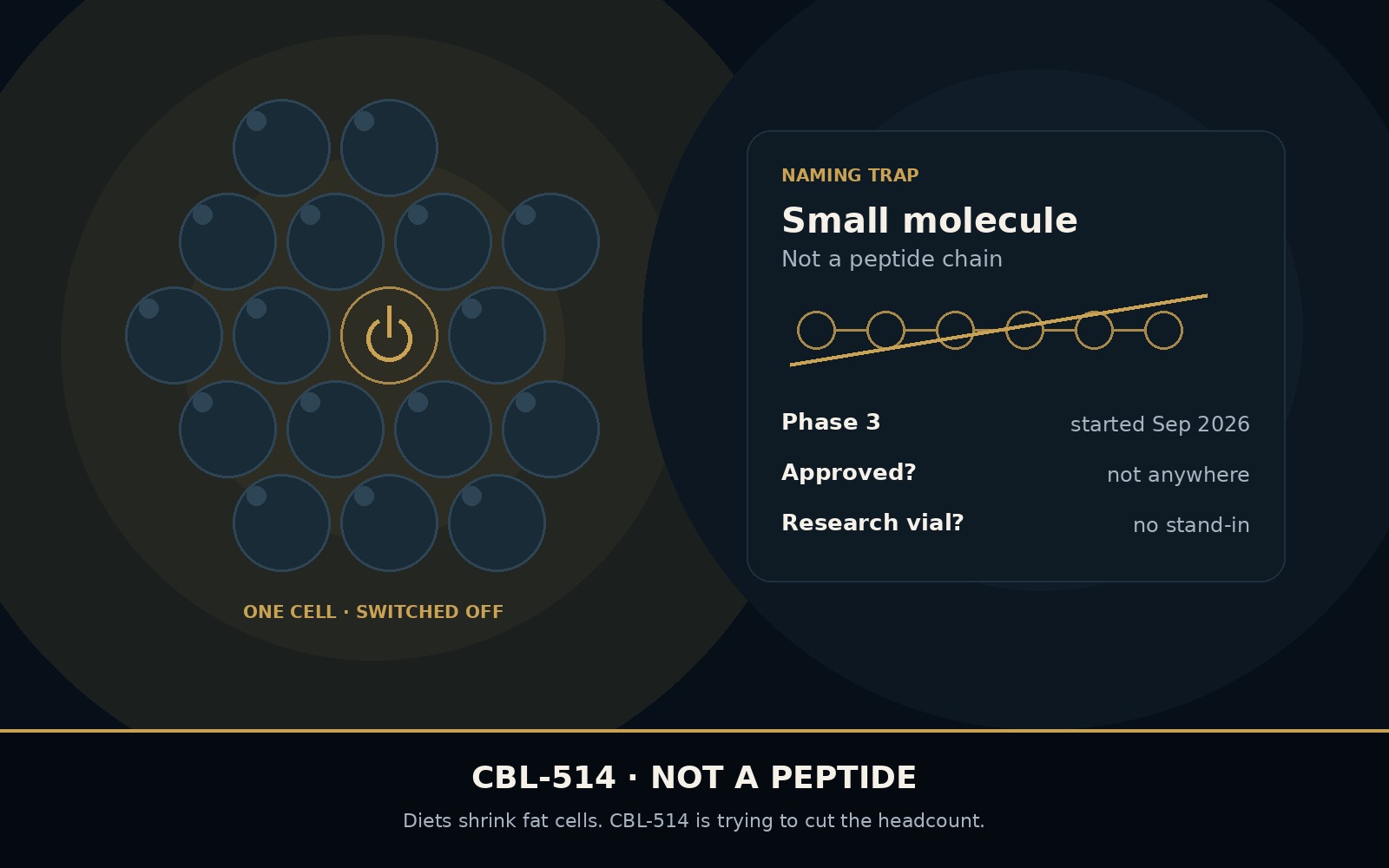
Diets shrink fat cells. CBL-514 is trying to cut the headcount.
What CBL-514 actually does
First, what it isn’t. A peptide is a short chain of amino acids, the building blocks of proteins (see What a peptide actually is). CBL-514 is a small-molecule drug, a different kind of chemistry altogether.
Fun twist: it isn’t one brand-new molecule, either. Caliway’s own trial protocol on ClinicalTrials.gov lists two active ingredients: curcumin (the yellow pigment in turmeric) and trans-resveratrol (a compound found in grape skin), made into an injectable solution. So it’s a set mix of two small plant-derived compounds.
And no, that doesn’t mean turmeric or resveratrol supplements do anything like this. Nobody has tested that, and the trial drug is injected straight into fat.
It’s injected into belly fat. Caliway says it triggers apoptosis, a tidy, built-in self-shutdown, in the fat cells near the injection site. Caliway’s own lab and animal work back that mechanism, and the company says it doesn’t damage the surrounding tissue.
Compare that with Kybella, an FDA-approved injection for fat under the chin. Its label says it physically breaks fat cell membranes. And it isn’t recommended for fat anywhere else.
Did it work in people?
In mid-size trials, yes. That’s human clinical trial evidence, mostly company-funded.
In a 2025 study of 76 adults, about 7 in 10 people on CBL-514 lost at least 150 mL of belly fat. That’s about two-thirds of a cup. Nobody on placebo hit that mark.
In a 2026 trial of 108 adults, MRI scans showed belly fat volume dropping about 20%. About three in four people on the drug improved at least one grade on a doctor’s fat-rating scale, versus about one in five on placebo. Side effects were mostly mild, temporary injection-site reactions.
Those are real signals. But both studies followed people for months, not years. And both were single-blind, meaning not everyone involved was kept in the dark about who got the drug.
What isn’t proven yet
Plenty.
No regulator has approved CBL-514. Phase 3 is the stage that’s supposed to confirm the earlier results in more people, and it just started.
The big new pitch is pairing it with weight-loss drugs. Caliway argues GLP-1 drugs only shrink fat cells temporarily, so cutting their number could help keep weight off. That’s a reasonable idea. But the combo evidence so far comes from animal studies, and the Zepbound trial hasn’t reported anything.
Nobody knows yet whether the fat stays gone for years. Those are exactly the questions Phase 3 exists to answer.
So where does a research shelf fit?
Honestly? It doesn’t, for this one.
Inspired Labs doesn’t carry CBL-514. It isn’t a peptide, and the trial version is a ready-to-use solution made for the studies. There’s no approved CBL-514 product to buy anywhere.
The Zepbound in that combo trial is a finished, labeled medicine. Our ILGLP-2 research family isn’t Zepbound and isn’t trial material. Read any research lot, ours included, by its own lot number and certificate of analysis (see How to read a certificate of analysis). And Research Use Only means lab work, not use in people.
The one thing to remember
CBL-514 is a promising small-molecule drug that tries to lower your fat cell count, not a peptide, and it won’t be a product until Phase 3 says so.
Sources
- 01Caliway — First patient dosed in Phase 3 SUPREME-01; ObesityWeek 2026 abstract — Caliway Biopharmaceuticals (2026). Company release.
Sep 23, 2026. Phase 3 dosing began; ~320 adults, US and Canada; randomized, double-blind, placebo-controlled. Describes CBL-514 as a first-in-class small-molecule injection designed to induce adipocyte apoptosis without necrosis. Preclinical combo study with semaglutide and eloralintide accepted for ObesityWeek (Washington, D.C., November). Company claims; forward-looking.
- 02Caliway — FDA clears CBL-514 + tirzepatide Phase 2; SUPREME-01 opens enrollment — Caliway Biopharmaceuticals (2026). Company release.
Aug 25, 2026. IND clearance for CBL-0201WR (CBL-514 with Zepbound, ~120 US adults, MRI endpoints). States the company’s view that GLP-1 drugs only temporarily shrink fat cells. EASD oral presentation on visceral fat scheduled Sep 30, 2026.
- 03Caliway — FDA IND clearance for second Phase 3 (SUPREME-02) — Caliway Biopharmaceuticals (2026). Company release.
May 22, 2026. Two pivotal Phase 3 studies planned; topline results anticipated in 2027.
- 04ClinicalTrials.gov — NCT07140939 (SUPREME-01) (2026). ClinicalTrials.gov.
Last updated Sep 22, 2026. Phase 3, randomized, triple-masked, placebo-controlled; recruiting; actual start Sep 1, 2026; estimated enrollment 320; primary completion est. Jul 2027. CBL-514 supplied as a ready-to-use injectable solution. Treatment schedule stays in the registry.
- 05ClinicalTrials.gov — NCT05234736 (Caliway CBL-0203 protocol) (2026). ClinicalTrials.gov.
Registry record and posted protocol (Version 1.0, Oct 18, 2021; uploaded Apr 22, 2026). Caliway’s Phase 2 pharmacokinetic study of CBL-514 in healthy volunteers. The protocol synopsis lists the active ingredient as “Curcumin and trans-resveratrol,” and the posted results say CBL-514 has two active pharmaceutical ingredients, curcumin and resveratrol. Concentrations and doses stay in the registry.
- 06Dynamics of fat cell turnover in humans — Spalding et al. (2008). Nature.
453: 783–787. Karolinska Institute. Used bomb-test carbon-14 in genomic DNA to date fat cells. Fat cell number stays constant in adulthood in lean and obese people, even after marked weight loss; about 10% renewed each year.
- 07CBL-514 randomized, placebo-controlled Phase 2 — Gold et al. (2025). Aesthetic Surgery Journal.
45(6): 611–620. Single-blind, 76 adults randomized 2:1. At 8 weeks after the last treatment, 69.6% on CBL-514 lost ≥150 mL abdominal subcutaneous fat vs none on placebo; injection-site reactions most common, mild to moderate. Company-affiliated authors. Doses stay in the paper.
- 08CBL-514 Phase 2b with MRI and rating scales — Lorenc et al. (2026). Aesthetic Surgery Journal.
Online May 20, 2026. NCT05736107. Single-blind, 108 adults. 76.7% vs 18.9% achieved ≥1-grade improvement on the clinician-rated scale; MRI fat volume about −20% from baseline; mainly mild, transient injection-site reactions. Company-affiliated authors.
- 09First published CBL-514 Phase 2a — Goodman et al. (2022). Aesthetic Surgery Journal.
42(11): NP662–NP674. Open-label proof-of-concept; describes apoptosis mechanism (caspase 3, Bax/Bcl-2, DYRK1b) from the company’s unpublished nonclinical reports.
- 10KYBELLA (deoxycholic acid) prescribing information — U.S. Food and Drug Administration (2015). FDA label (NDA 206333).
Initial US approval 2015. Cytolytic drug for moderate-to-severe submental fullness in adults; physically destroys cell membranes causing lysis; use outside the submental region not established and not recommended. A 2025 systematic review (Plast Reconstr Surg, PMID 41296813) confirms deoxycholic acid as the only FDA-approved agent for submental fat reduction.
- 11Catalog adjacency and how to read the gap (2026). Inspired Labs Journal.
Live Journal: What a peptide actually is, How to read a certificate of analysis (https://b4pep.com/blog/coa-is-not-a-vibe), What Research Use Only actually means (https://b4pep.com/blog/ruo-is-a-fence). Catalog snapshot used by this Journal (Oct 6, 2026): no CBL-514 family. The ILGLP-2 research family is not Zepbound and not trial material.
Educational material for laboratory research context only. Nothing here is medical advice, a protocol for human use, or a claim that Inspired Labs products diagnose, treat, cure, or prevent disease.
Continue

Your Muscle Noticed Menopause. Science Still Points at Iron.
After menopause, honestly
Your Muscle Noticed Menopause. Science Still Points at Iron.
Read brief → 3 min

Your Tendons Are Still Running on Your Teenage Collagen
Recovery, honestly
Your Tendons Are Still Running on Your Teenage Collagen
Read brief → 3 min

The Holiday Pound Is Small. It Just Never Leaves.
Weight, honestly
The Holiday Pound Is Small. It Just Never Leaves.
Read brief → 3 min