
Naming trap/Compounds
Kisspeptin Is Not a Testosterone Booster
It’s named after a chocolate, it started life as a cancer gene, and your feed calls it a natural testosterone booster. The real story is better: kisspeptin is a doorbell, and holding the bell down can make the house go quiet.
Inspired Labs Editorial/Oct 6, 2026/8 sources
Kisspeptin Is Not a Testosterone Booster
In 1996, a lab in Hershey, Pennsylvania, found a gene that seemed to slow the spread of melanoma cells. They named it KiSS-1, after the town’s famous chocolate.
Thirty years later, your feed calls the peptide made from that gene a “natural testosterone booster.” Here’s the thing: kisspeptin is real, it does sit upstream of testosterone, and the human studies are genuinely interesting. But it works like a doorbell, not a dial. And holding a doorbell down has a funny way of backfiring.
Literature, not lore.
Wait, it started as a cancer gene?
Yep. Kisspeptin’s first job title was “metastasis suppressor,” because melanoma cells that made it spread less in early lab and mouse work.
The “SS” stood for suppressor sequence. The “Ki” was a nod to Hershey’s Kisses. Scientists get to have fun sometimes.
Then in 2003, researchers found something bigger. People born with a broken kisspeptin receptor, the lock this peptide fits, didn’t go through puberty on their own.
That was the clue. This little peptide sits near the very top of the reproductive chain of command.
So what does it actually do?
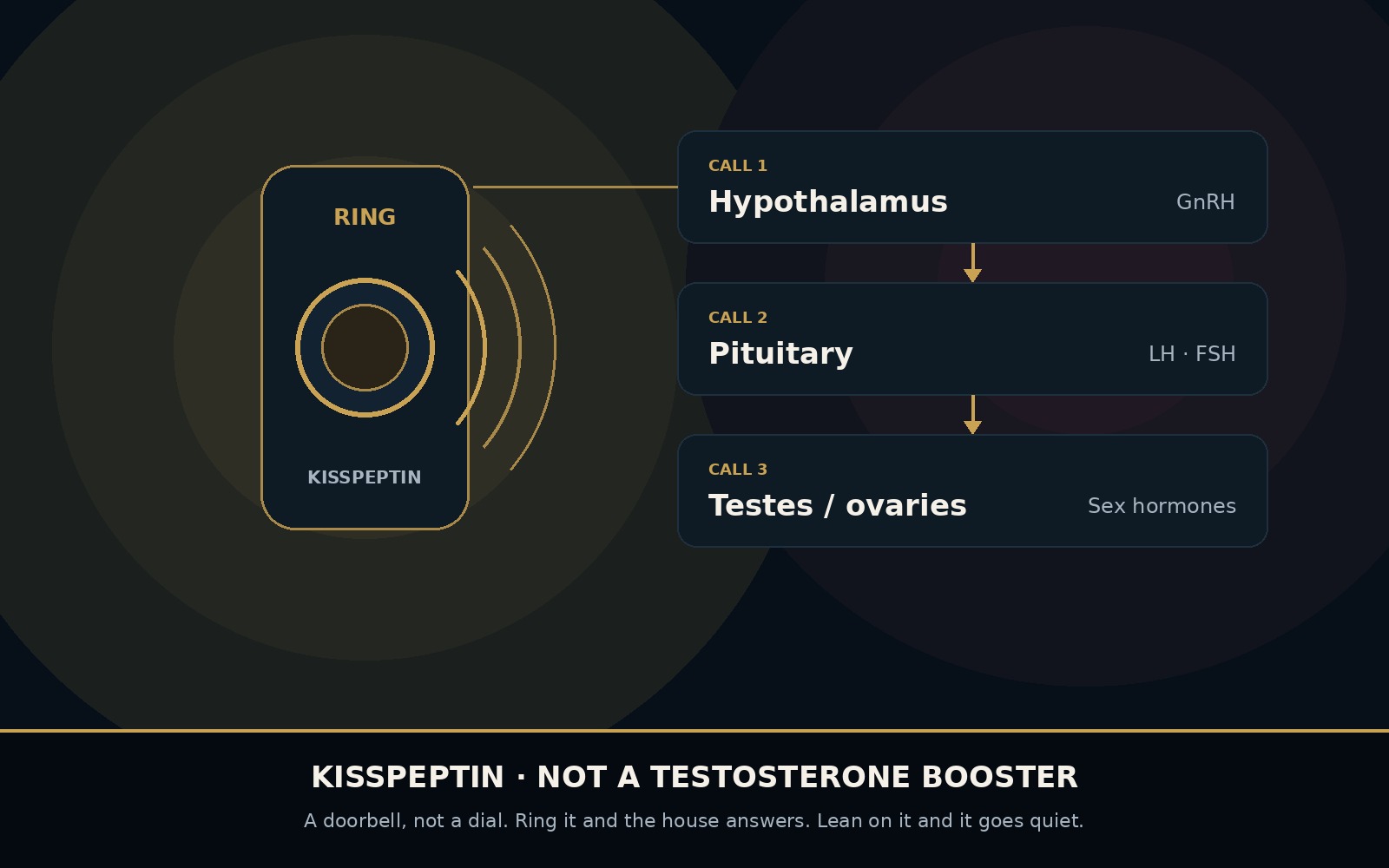
Picture your hormone system as a house. Kisspeptin rings the doorbell.
The bell sounds in the hypothalamus, a small brain region that runs many of the body’s thermostats. It answers by sending a signal called GnRH to the pituitary, the body’s hormone dispatcher.
The pituitary then sends two messenger hormones, LH and FSH, to the testes or ovaries. That’s where testosterone and estrogen get made.
So kisspeptin doesn’t make testosterone. It starts a phone tree that, three calls later, can end with testosterone.
Your body makes one long version, kisspeptin-54, plus shorter pieces. Kisspeptin-10 is the last ten letters of that chain, the smallest piece that still rings the bell. (New to peptides as sentences? Start with What a peptide actually is.)
Has anyone tested it in people?
More than most peptides on your feed, which is refreshing. One team at Imperial College London has run much of this work.
In a small IVF trial, they used kisspeptin-54 to trigger the final step of egg maturation in 60 women at high risk of over-responding to standard triggers. Eggs matured in 95% of them. That’s early human research: encouraging, but small.
The same team ran randomized trials in people with long-lasting low sexual desire, one in women and one in men. During a single session on kisspeptin, brain scans showed more activity in sex-related regions while people watched intimate videos.
Those are real randomized human trials. They were also short, small, and one visit each. That’s a promising lead, not a verdict.
Then why isn’t it a testosterone booster?
Because of what happens when you lean on the bell.
In August, the Imperial team published a small study of 15 healthy men given kisspeptin-10 under the skin over many days. Run nonstop for five days, the pituitary’s messages faded back toward normal, even though testosterone hadn’t dropped yet. Run in daily on-and-off rounds, the messages kept coming for 12 days.
Years earlier, Takeda tested a long-lasting kisspeptin look-alike called TAK-448. Held on steadily for two weeks in healthy older men, it pushed testosterone down, not up. Way down.
That’s the twist your feed skips. Rhythm rings the bell. A constant press can make the house stop answering.
Kisspeptin is a doorbell. Ring it and the house answers. Lean on it and the house stops coming to the door.
So is it approved for anything?
No. We found no FDA-approved kisspeptin medicine. Everything above happened in hospital research units, with study-grade product and blood draws every few minutes.
If you read our PT-141 piece, you know the libido aisle already has one labeled drug. Kisspeptin isn’t it, at least not yet.
What about the vial on a research shelf?
Inspired Labs carries Kisspeptin-10 as a research reagent. It shares a name with the peptide in that August study. A shared name isn’t a shared trial, and a vial isn’t a protocol.
Read any research lot, ours included, by its lot number and its certificate of analysis. How to read a certificate of analysis walks you through it.
Research Use Only means laboratory research, not use in people. That fence stays up no matter how cute the chocolate story is.
The one thing to remember
If you remember one thing: kisspeptin is the doorbell at the top of the hormone house, not a testosterone pill, and in studies, holding the bell down made the house go quiet.
Sources
- 01KiSS-1, a novel human malignant melanoma metastasis-suppressor gene — Lee et al. (1996). J Natl Cancer Inst.
88(23): 1731–1737. PMID 8944003. Penn State College of Medicine, Hershey. Identified KiSS-1 as a melanoma metastasis-suppressor gene in cell and mouse work. Penn State’s Dec 1996 release notes the name was inspired by the Hershey candy and that “SS” stands for suppressor sequences.
- 02The GPR54 gene as a regulator of puberty — Seminara et al. (2003). N Engl J Med.
349(17): 1614–1627. PMID 14573733. Loss-of-function changes in GPR54, the kisspeptin receptor, were linked to absent puberty (hypogonadotropic hypogonadism).
- 03Kisspeptin-54 as an IVF trigger in women at high risk of OHSS — Abbara et al. (2015). J Clin Endocrinol Metab.
100(9): 3322–3331. PMID 26192876. Phase 2, open-label, randomized dose allocation; 60 women at high risk of ovarian hyperstimulation syndrome, Hammersmith Hospital, London. Oocyte maturation in 95%. Dose arms stay in the paper.
- 04Kisspeptin in women with low sexual desire — Thurston et al. (2022). JAMA Netw Open.
5(10): e2236131. PMID 36287566. Randomized, placebo-controlled crossover, single-session.
- 05Kisspeptin in men with low sexual desire — Mills et al. (2023). JAMA Netw Open.
6(2): e2254313. PMID 36735255. Double-blind, placebo-controlled crossover; 32 men completed; one 75-minute infusion visit per arm. Changes in sexual-brain processing on fMRI plus secondary arousal measures. Interval estimates stay in the paper.
- 06Multi-day kisspeptin-10 in healthy men — Yeung et al. (2026). Eur J Endocrinol.
Aug 3, 2026; 195(2): 206–216. PMID 42549827. Imperial College London. Randomized, single-blinded, placebo-controlled; 15 healthy men plus 12 controls. Continuous five-day administration: gonadotropins similar to placebo while testosterone remained elevated. Daily intermittent administration: gonadotropin rises sustained over 12 days. Rates and schedules stay in the paper.
- 07TAK-448, a long-acting kisspeptin analog — MacLean et al. (2014). J Clin Endocrinol Metab.
99(8): E1445–E1453. PMID 24762108. Two Phase 1 studies (Takeda). In healthy men 50 and older, single doses raised testosterone, while 14-day continuous exposure drove it below baseline and then to very low levels. Doses stay in the paper.
- 08Catalog adjacency and how to read the gap (2026). Inspired Labs Journal.
Live Journal: How to read a certificate of analysis and What Research Use Only actually means (https://b4pep.com/blog/ruo-is-a-fence). Catalog projection used by this Journal (Oct 1, 2026): Kisspeptin-10 research reagent family present with a posted COA. Soft reading adjacency only. A research lot is not a trial product and not an approved medicine.
Educational material for laboratory research context only. Nothing here is medical advice, a protocol for human use, or a claim that Inspired Labs products diagnose, treat, cure, or prevent disease.
Continue

Your Muscle Noticed Menopause. Science Still Points at Iron.
After menopause, honestly
Your Muscle Noticed Menopause. Science Still Points at Iron.
Read brief → 3 min

Your Tendons Are Still Running on Your Teenage Collagen
Recovery, honestly
Your Tendons Are Still Running on Your Teenage Collagen
Read brief → 3 min

The Holiday Pound Is Small. It Just Never Leaves.
Weight, honestly
The Holiday Pound Is Small. It Just Never Leaves.
Read brief → 3 min